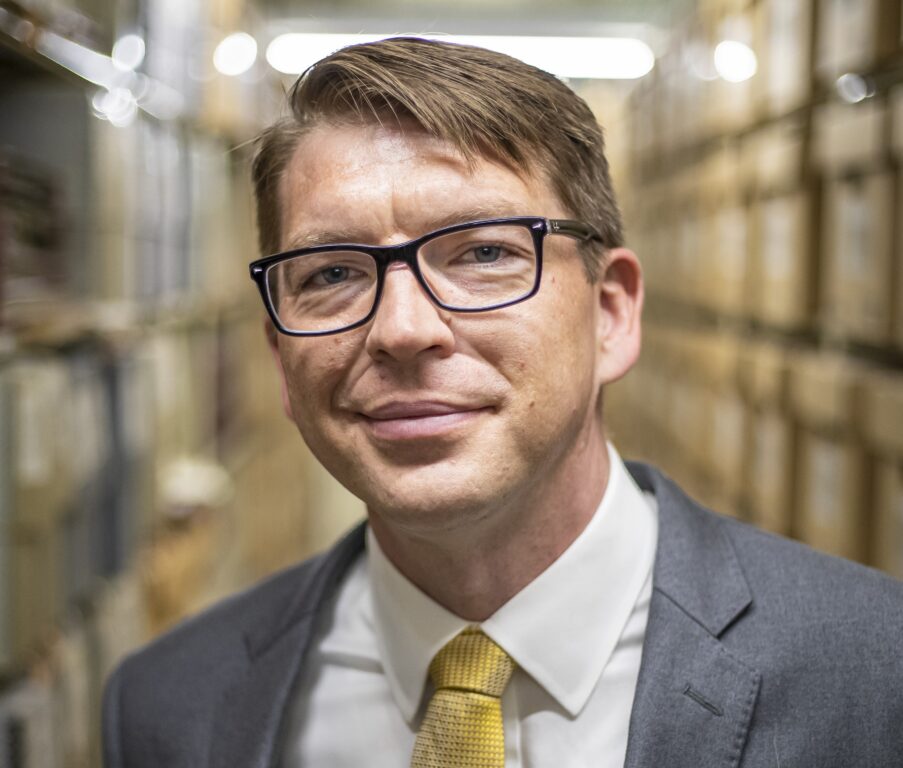
The University of Idaho’s Library has changed its hours for the current academic year due to state funding cuts. Compared to last year, the library is now open “a little bit later and closing a bit earlier,” as put by UI’s Dean of University of Libraries and Chief Data and AI Officer, Ben Hunter. In addition to new hours, the library is joined by the entire university in new integrations of AI.
“The decision came about . . . because of the budget cuts that came from the state last year,” Hunter explained. With a faculty librarian leaving and a staff member retiring, the library had to “accommodate their departures and give up certain things,” including long hours of operation.
Hunter is a third-generation UI graduate, who began as an entry level librarian and assistant professor in 2006. Hunter stated that he “worked [his] way up,” becoming an Associate Dean for the library and then Dean in 2018. The change of the library’s hours, Hunter said, “ultimately was my decision.”
The library used to open at 7 a.m. and close at 2 a.m. on weekdays. This academic year, the change was made to 7 a.m. to 12 a.m. Monday through Thursday, and 7 a.m. to 8 p.m. on Fridays. Weekend hours were also revised to 12 p.m. to 6 p.m. and 12 p.m. to 12 a.m. on Saturdays and Sundays, respectively.
The budget cuts Hunter described include House Bill 876, passed by the state legislature Thursday, March 26, 2026. This bill was described by the senators to be a maintenance budget for the State Board of Education. The result was, as described by the Idaho Statesman in an article covering the passing of the bill, “millions of dollars in cuts to Idaho’s colleges and universities.”
Gate counters in the library track the flow of traffic in and out, and hours were cut with this foot traffic in mind. “We did everything we could to trim the hours where we saw the lowest traffic,” Hunter says.
“It’s disappointing . . . ideally we would love to be open 24 hours.” Given the budget cuts the university got, including the library, compromising was something Hunter had to face. “It’s hard because we have an amazing team of people . . . we’re very fortunate that we have such a great community that we serve and such a great team to serve them. When things are going that well . . . to get punched in the mouth, it’s frustrating.”


Still, Hunter recognized the unique position of the UI Library. “We’re able to offer things to our community that libraries with double our funding aren’t able to do . . . just the range of services, the collections we’re able to offer, it’s pretty remarkable.”
The UI Library has their makerspace the MILL, which is free and available to everyone. There is also a recording studio, with a sound isolation booth, recording equipment and a setup like a podcasting studio. On the second floor, librarians can help students with their research at the reference desk. They also work directly with the writing center, which offers tutoring.
The data hub has also expanded to include help with using AI. “Technology has never been totally green, and AI is even less green, in a way people are really noticing. We want to help people understand and navigate and think about how to use it responsibly.” Hunter explains. The library is neither pro-AI nor against AI, but rather “pro-understanding AI [as] something we really feel is important for students.”
An AI search tool has been integrated into the library’s main catalogue, the library search. The library also maintains the research information management system VERSO, which contains faculty papers and profiles. “Our team has built UniVERSO on top of that, which is an AI layer that helps people do major querying. . . able to look at all the data we’ve curated” said Hunter. “In the end, libraries are all about data, information and knowledge, and that is what AI is built on. We recognize our responsibility to help students navigate that.”
Ultimately, Hunter described the library as a place for everyone, with information and scholarly communication for every discipline and person.
“There is no one who is not welcome here . . . it’s an interdisciplinary space; it’s for everybody.” And although “books are the library brand, [the library] is so much more.”
Maddie Wright can be reached at [email protected]