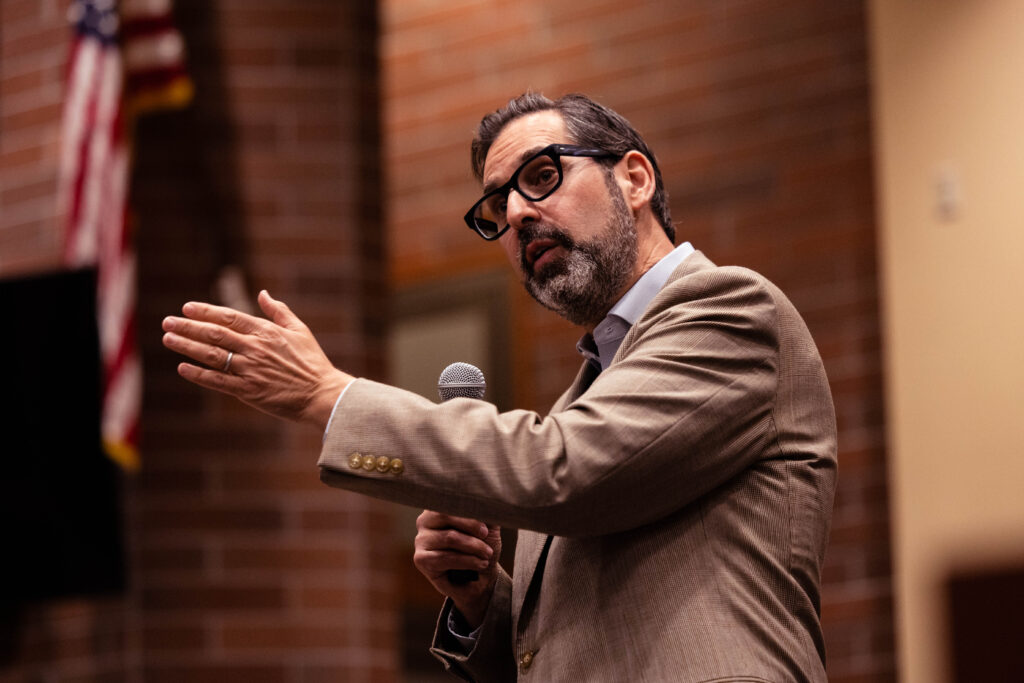
Nearly 80 people filled the courtroom in the University of Idaho Menard Law Building, not for a court hearing, but for the 14th annual Oppenheimer Ethics Symposium.
The keynote speech was given by David Folkenflik, a media correspondent for NPR, who covered censorship, the growing pressures media professionals face and the important role journalists have in bearing witness to the world around them.
Folkenflik began by discussing his early journalism experience, where he focused on covering reality TV show Big Brother. Folkenflik explained how the show premise surrounding constant surveillance reminded him of the philosopher Jeremy Bentham’s panopticon prison design.
In the design, a single warden sits in the center of a circular room, able to look anywhere, but not everywhere. The possibility that the warden is looking at a given prisoner is enough to keep them in check.
He believes that journalists need to bear witness directly, unlike how a panopticon prison works. Not only that, but they need to accurately reflect the ideas that the people they write about represent.
“I’m proud about the degree to which we reflect people in their own words, in their own voices, and try to take their opinions, thoughts and perspectives seriously,” Folkenflik said.
Folkenflik talked about some significant examples of bearing witness in major investigative reporting stories.
The Boston Globe’s uncovering of child molestation in Catholic churches would not have happened without journalists bearing witness to wrongdoing.
Folkenflik believes that journalists need to play the role of bearing witness and believes that building trust through fair and consistent reporting is how they achieve this.
He recalled visiting a man’s home at 10 p.m. only to get yelled at by the wife for showing up at such a late hour in the night. He said he was transparent about his motives; he was there because he had witnessed that man being treated unfairly. After being invited in and talking until 1 a.m., he was
able to gather documents that supported the unfair treatment he believed the man was experiencing.
Folkenflik also spoke about the external pressures which shape the press, often away from its core values.
“We are the subject of our own personal strengths and imperfections, but increasingly we are finding that the press is subject to pressure as well,” Folkenflik said.
He pointed to the federal government as a key contributor to the conflict.
One instance Folkenflik described involved Brendan Carr, head of the Federal Communications Commission, opposing Jimmy Kimmel appearing on ABC. This was in response to comments Jimmy Kimmel had made regarding the assassination of Charlie Kirk.
This led to Nexstar Media Group and Sinclair Broadcast Group, the two largest TV stations, pulling ABC and the “Jimmy Kimmel Live!” show from their broadcast. Folkenflik explained that this could have been related to both media groups currently pending federal communication approval.
Despite the external pressure, Folkenflik continued to emphasize how fairness and transparency are vital in the media’s role of bearing witness.
Folkenflik had previously been invited to attend the event in 2020 which was eventually changed to a 2021 Zoom meeting due to COVID-19.
The Oppenheimer Ethics Symposium, named after UI alumni Doug and Skip Oppenheimer, is an annual event where speakers talk about ethical issues facing the media landscape.
Dominic Dorigo can be reached at [email protected].