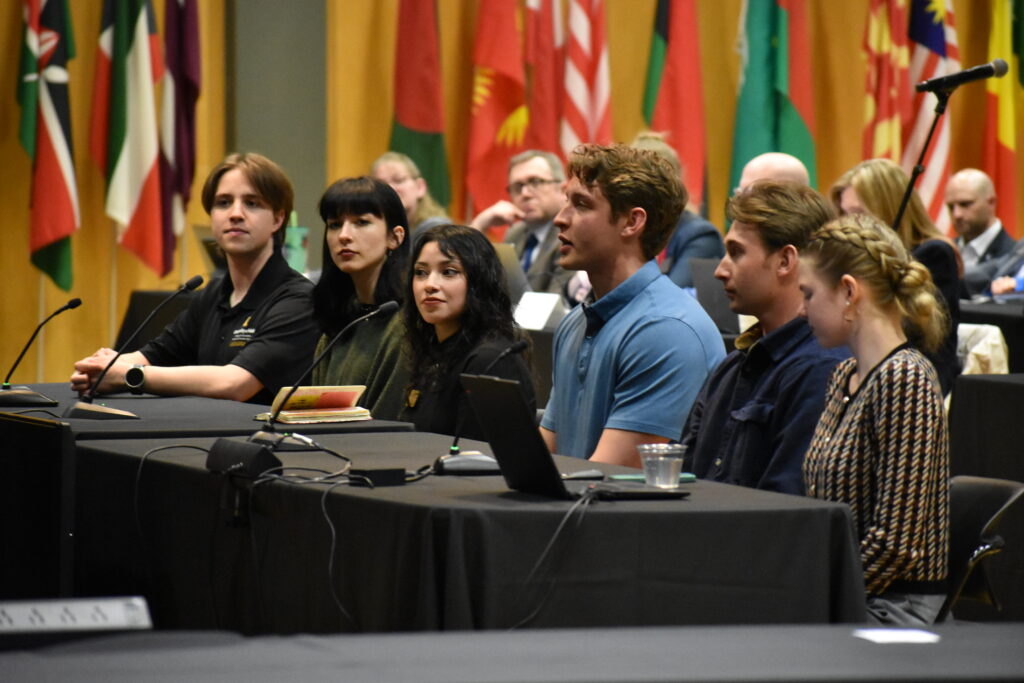
The Idaho State Board of Education heard from University of Idaho students, staff and faculty on their concerns for higher education on the first day of the board meeting in Moscow.
Debbie Critchfield, Idaho’s superintendent of education, asked the student panel what they see in their futures and what challenges they anticipate.
“I’m part of the College of Science and there’s a lot of uncertainty with AI right now. There are some people who are really for it. I personally am not. But there’s a lot of, we don’t know what it looks like. We don’t know if these degrees we’re getting are going to be worth anything. Will our jobs still be there?” Reagan Johnson, a senior studying mathematical biology, said.
Bobby Provost, a senior studying mechanical engineering, mentioned rapid growth at UI. “That leads to bigger class sizes and the professors are more stressed and stuff like that. And as we get to that direction, I think it’s going to remove some of the hands-on aspect of engineering that I really like at the school,” he said.
Owen Allenger, a junior studying elementary education and a resident adviser on campus, mentioned limited housing space for students on campus. “As students move off campus or they live at home, one of the big issues is that then they don’t have that community and connection with other students that I feel like the college experience is amazing for,” he said.
Faculty are also uncertain about the future of education amidst rapidly evolving technological climates.
“One of the top concerns is what AI is going to do for them and what it means for their jobs upon graduation,” Sanjay Sisodia, department head for the Department of Business and a professor of marketing, said. “When we look at the information outputs that we get from, say, AI, do we take it for granted or do we say, critically, is this an adequate set of results or outputs that I’m getting that I should consider? So, is it more of a tool or a replacement?”

UI president Scott Green delivered UI’s annual report to the board of education, providing updates on the university’s strategic plan.
Due to state funding cuts, UI intends to reduce certain programs, such as engineering, cybersecurity, agriculture, veterinary medicine, health care and mining. UI is also delaying hiring, reducing travel and discretionary spending and offering an incentivized retirement program.
Green spoke about the Washington, Wyoming, Alaska, Montana and Idaho medical education program and plans for UI to partner with the University of Utah to expand medical education in the state. He also mentioned the university’s plans to develop a master of science in nursing program, partnering with North Idaho College.
“We’re preparing students for the jobs of tomorrow,” Green said. He highlighted programs such as the upcoming master’s and bachelor’s degrees in artificial intelligence and a “Reimagining Teaching with AI” series for faculty.
In 2025, UI received a $4.5 million grant from the National Science Foundation to build tools such as the Vandalizer, which uses AI to streamline tedious tasks into one-click steps.
“Tasks that used to take staff up to an hour are now done in seconds. This is already saving our Office of Sponsored Programs thousands of hours per year. Universities around the country are clamoring for our tool, and we have begun distributing it last month, which allows employees to focus on higher value work that advances discovery,” Green said.
Green mentioned UI’s trends of growth over the last decade, saying that he anticipates enrollment will begin to decline.
“Applications are down. And I would say we have other factors that would indicate that enrollments may be flat to maybe even slightly up. We have a record number of FAFSA forms on file, but not all those people have enrolled. So we have a lot of conflicting data,” Green said. “Maybe they’re applying to fewer schools, and so far, our yields are good…But I’m bracing the campus that enrollments could be down this year for the first time in five years.”
UI also requested that the board allow the university to begin planning and design for the Idaho Water Center Laboratory and Classroom Improvement project, which will provide medical education classrooms in the existing Water Center building in Boise. Sunny Wallace, chief of staff at UI, addressed the board.
“We’ll have a dedicated classroom there, study spaces, lockers, faculty and staff offices,” Wallace said. “The dual-site approach ensures that we can fully meet accreditation and program requirements while leveraging partnerships and existing state assets to deliver a high-quality, cost-effective undergraduate medical education program for Idaho.”
The board unanimously approved UI’s request to begin planning and design, for an amount of $467,045.
UI is also contributing financially to the construction and improvement of Idaho State University’s Meridian anatomy lab, which will accommodate UI and University of Utah medical students beginning in the fall of 2028.
Dakota Steffen can be reached at [email protected].