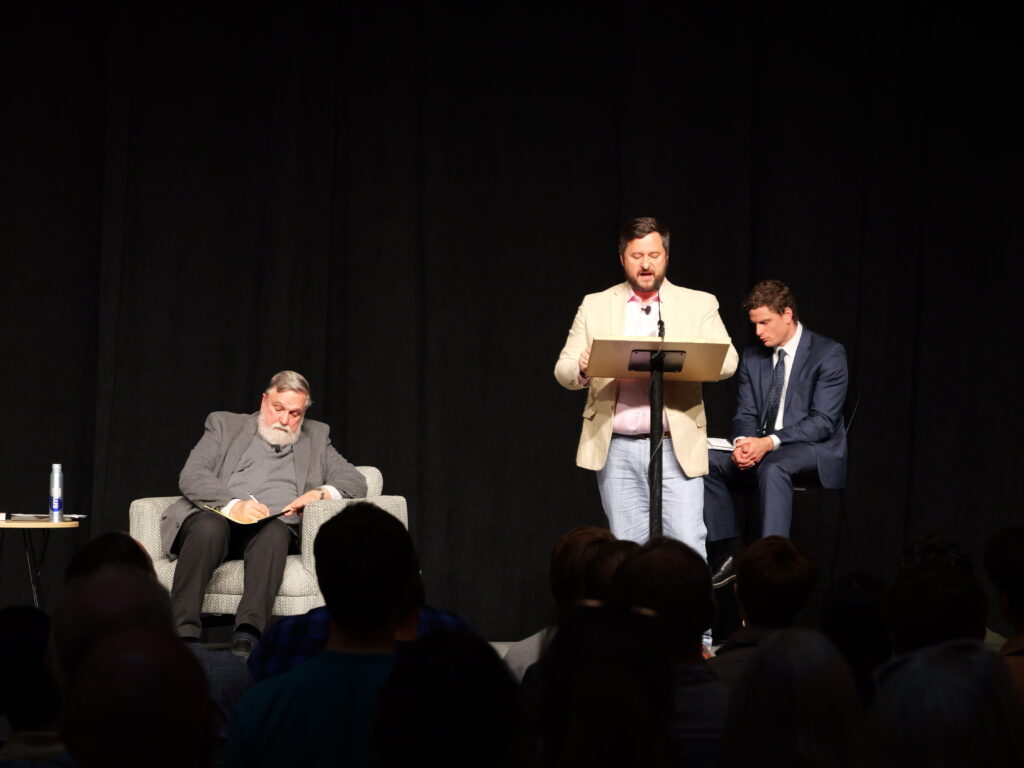
The sixth annual Great Debate presented Douglas Wilson, arguing on behalf of Protestant beliefs, against Joe Heschmeyer, arguing on behalf of Catholic beliefs at the ICCU arena on Thursday, March 16. The topic of the debate was Sola Scriptura – is Scripture alone enough?
Wilson’s opening argument took the affirmative of Sola Scriptura, defending the belief that the Bible is the sole infallible and ultimate source of authority that Christians should follow. Sola Scriptura relies on personal interpretation, which allows individuals to make decisions dependent on what they determine to truly align with Scripture.
Wilson, the senior pastor of Christ Church in Moscow, received a bachelor’s degree in philosophy, a bachelor’s degree in classical studies and a master’s degree in philosophy from the University of Idaho.
“Scripture alone, all 66 books, is the only spiritual authority in our lives that has the twin characteristics of ultimacy and infallibility,” Wilson said. “My view includes all of Scripture, front to back, side to side, and only Scripture.”
Wilson went on to describe an evolution of traditions found in the church. Tradition zero can be defined as “solo scriptura,” a Christian and their Bible – with no other fellowship – against the world. Tradition one is Sola Scriptura, a popular Protestant belief where Scripture alone has the final say.
“The Scriptures are the sole material basis and doctrine to be interpreted by the church in the light of the gospel,” Wilson said of tradition one.
Tradition two encompasses the idea that the Bible and traditions orally passed down through the church are to be treated with the same respect, which is the most common belief held by the Catholic church. Tradition three is a more recent development in the Catholic church, where the only source of revelation is from the Rome magisterium.

“When it comes to teaching the people of God what God wants us to know, does the church use the truth from one [source] or from two?” Wilson said. “The Protestant says one. Tradition one. Scripture alone. The Roman Catholic says there are two quarries. Tradition two. Scripture together with traditions handed down from the apostles.”
Wilson argued that the Catholic stance lacked specificity and relies on personal inability to interpret Scripture. For specificity, Wilson clarified that the Protestant Bible contains 66 books, listed in a table of contents. Catholics, on the other hands, not only have seven more books added to their Bible, but also lack a set of written transcripts of church traditions. For a newcomer to the Catholic faith, Wilson argued, how would they know what rules or interpretations they’re signing up to agree to?
Wilson also emphazised that whether a Christian believes in the church’s supreme authority of truth, it still boils down to a personal interpretation. For Protestants, interpretation is left to the mind of individuals, which is shown through the resulting numerous denominations of the church. For Catholics, although they all align on interpretable beliefs, someone – whether the current pope or one of the past – had to make a decision about what they personally believed to be true.
Heschmeyer countered Wilson’s claim. He instead believes that while the Scripture is an infallible source of authority or truth in a Christian’s life, the church also provides the same infallible authority through interpretation and traditions. He argued that God promised his believers all truth, as found in John 16:13, and this alludes to the God-given authority of the church as the enlightener of this truth.
Heschmeyer works as an apologist for Catholic Answers and holds a bachelor’s degree in philosophy from Kenrick-Glennon Seminary, a degree in sacred theology from the Pontifical University of St. Thomas Aquinas in Rome and a Juris Doctor from Georgetown University.
Heschmeyer quoted the apostle Paul, who instructs his audiences in both Second Thessalonians and First Corinthians to keep apostolic traditions, both spoken and written. Heschmeyer illustrated that the way Paul’s followers in the first century had spoken traditions that were passed down is the way the Catholic church currently has traditions.
Heschmeyer claimed that, if an instructor is teaching a lesson on some topic, and the audience of that lecture walks away without an understanding of that topic, then the instructor has failed. In the same way, if God provided Scripture – which contains many passages that may not be understood on the first read through – without means to understand the Scripture, then he has failed. Therefore, the church’s authority acts as God’s means to understanding for believers.
“Why is Sola Scriptura not enough?” Heschmeyer said. “It is self-refuting… [and] the doctrine of Sola Scriptura is not itself in Scripture.”
Heschmeyer also addressed Wilson’s point of specificity. Protestants adhere to the 66-book canon because it was a decision made by man, he claimed, not because it was expressly laid out in Scripture. Likewise, the Catholic church follows a 73-book canon and traditions of the church, and the Scripturedoes not say that those should be exluded.
Heschmeyer likened the doctrine of Sola Scripture to a mosaic of a king – with just the pieces of the mosaic, one could create another mosaic of a lion, or a bird. However, with the correct outline, or the interpretations and traditions of the Catholic church, everyone would be able to create the image of the king.
Wilson then presented his rebuttal, in which he reasserted the lack of set or written traditions of the church and the problems that arise with that. He claimed that the church and its authority is not ultimate or infallible, and that can be seen through the history of Catholicism. He presented Deuteronomy 6:4-9 and Galatians 1:8-9 as Biblical proof for Sola Scriptura.
Heschmeyer, in his rebuttal, withstood that the reason for a clean canon, in both Protestant and Catholic Bibles, is church traditions and decisions. Additionally, he demonstrated the disunity in Protestant beliefs. Two good Protestants can discuss core theological disagreements and walk away with different views, he said, but two good Catholics will agree.
The event was moderated by Gracjan Kraszewski, the director of intellectual formation at Vandal Catholic.
Rebekah Brown can be reached at [email protected].