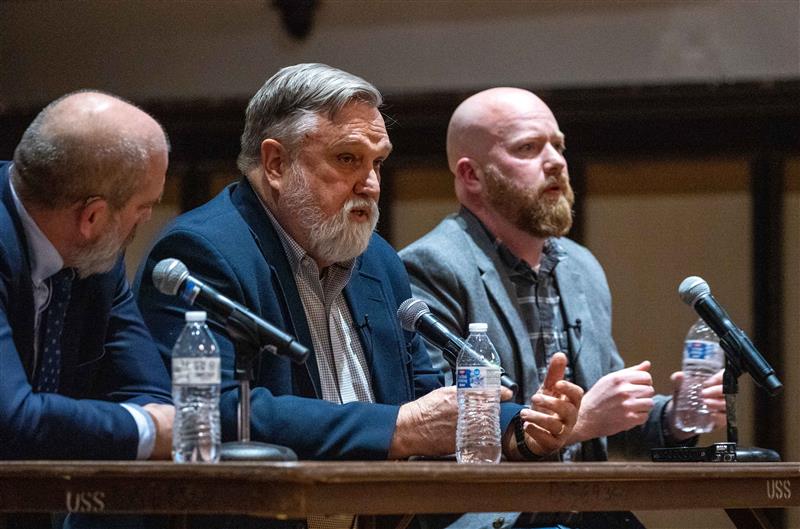
Universities often describe themselves as marketplaces of ideas, places where opposing perspectives can meet in open dialogue. That goal will be tested at the University of Idaho as representatives from the Catholic Church and Moscow’s Christ Church gather for a public debate on theology, authority and doctrine.
Joe Heschmeyer, a catholic apologist, will debate Doug Wilson, the senior pastor of Christ Church, on Thursday, March 26, at 7 p.m. in the ICCU Arena. The event has generated significant interest among students and community members alike. Debates between different Christian traditions are not new, but hosting one on a university campus gives the conversation a unique academic dimension. For many students, it represents an opportunity to witness a direct exchange of ideas about faith, scripture and church authority.
Yet alongside the anticipation surrounding the debate, another conversation has emerged. Students have learned that attending the event requires purchasing a ticket, even though the debate is being hosted by the university itself.
However, students can gain free tickets through the catholic church’s webiste, using the promo code: “augistine.”
The debate itself is likely to draw attention far beyond the campus. Christ Church has been a central figure in Moscow’s religious landscape for years, often sparking intense conversations about its theology, leadership and growing presence in the community. The Catholic church, meanwhile, represents one of the oldest and most globally influential Christian traditions.
Bringing these perspectives together in a structured debate has clear educational value. Universities are uniquely positioned to host discussions that might otherwise remain confined to churches or religious institutions. A campus setting allows students from different backgrounds to observe, question and analyze the arguments being presented.
Debates also serve a different purpose than lectures or panel discussions. Instead of simply presenting viewpoints, debates require participants to directly respond to one another. Claims must be defended, criticisms must be addressed and ideas must stand up to scrutiny in real time.

For students studying philosophy, political science, history or religious studies, this kind of event can be especially valuable. It demonstrates how complex ideas are tested through argument and dialogue, something universities frequently encourage in classrooms but rarely showcase on a public stage.
That is part of the reason the event generated excitement when it was first announced.
However, the ticket requirement has complicated that excitement. Many students already pay significant tuition and fees to attend the university. Those fees support everything from campus facilities to student programming and guest speakers.
The fee waiver for students has helped the tickets become more available, but students have to keep up with the church’s website and social media to be made aware of the promotional code. Making the promotional code more accessible would help more students and diverse perspectives be able to attend.
That outcome affects more than just attendance numbers.
Debates rely heavily on audience engagement. The presence of a diverse audience helps ensure that discussions resonate beyond the speakers themselves. Students bring their own perspectives, questions and reactions to the event, shaping how ideas are received and interpreted.
When fewer students attend, the broader educational impact of the debate may be reduced.
Supporters of the ticket price point out that events like this require resources to organize. Venues must be prepared, security arranged and logistical details handled. Charging admission can help offset those costs and ensure the event is run professionally.
Those practical concerns are understandable. Large public debates do not simply appear overnight, and universities must manage their budgets carefully.
Still, the optics of the situation have become part of the discussion. When a university promotes itself as the host of an intellectual debate, many students expect that the campus community will have easy access to the event.
The debate between representatives of the Catholic church and Christ Church will likely generate strong arguments and passionate reactions. Questions of doctrine, authority and interpretation have shaped Christian history for centuries, and they remain deeply meaningful to many believers today.
Hosting that conversation on a university campus has the potential to elevate the discussion. Students and community members alike can witness how religious ideas are debated, defended and challenged in a public forum.
That is exactly the type of intellectual exchange universities often say they want to promote.
But if the goal is truly to encourage dialogue, accessibility matters. Students should feel invited to participate in the conversations their university brings to campus.
In the end, the debate itself may be remembered for the arguments presented on stage. Yet the discussion surrounding the ticket price highlights a broader question facing universities everywhere: how to balance the costs of hosting events with the mission of keeping intellectual engagement open to all students.
More information about the debate can be found on the Vandal Catholic Website.
AJ Pearman can be reached at [email protected].
Dale
This comment is awaiting moderation.