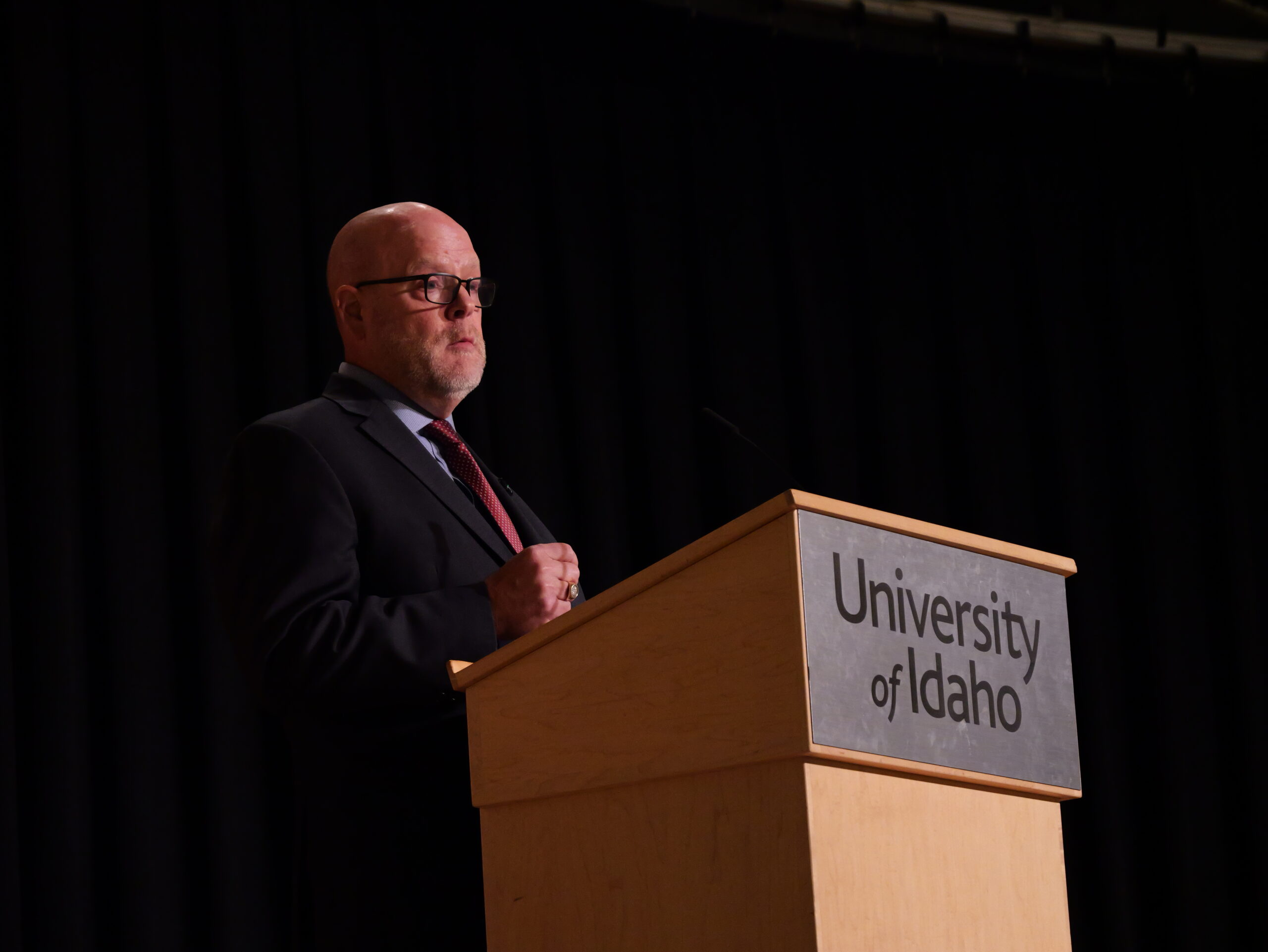
“American power is most effective when it is exercised in partnership with Europe.”
This was one of the central messages former U.S diplomat Jeff Hovenier spoke about on Feb. 4 in the International Ballroom at the University of Idaho. Hovenier covered various topics surrounding diplomatic relations between the United States and other countries, underlining the importance of alliances in an unstable global landscape.
Hovenier is a U.S. diplomat with 35 years of service across Peru, Croatia, Greece, Panama, Germany and Paraguay. Former President Joe Biden nominated Hovenier to serve as a United States Ambassador to Kosovo in 2021.
He argued during his talk that alliances don’t find strength by the absence of conflict, but through the ability to manage disagreements without damaging the relationship.
“Healthy alliances are not defined by the absence of disagreement,” Hovenier said. “They’re defined by the presence of mechanisms to manage disagreements without calling the relationship into question.”
Hovenier then described NATO’s success, citing expansion into Central and Eastern Europe as an effort to support new democracies emerging, noting that the United States played a key role in helping former communist states choose their own arrangements. He also pointed to NATO’s role in stabilizing the Balkans following violent conflict as an example of successful multinational cooperation.
Hovenier asserted NATO as the most successful defensive alliance in history, combining American military with European geography. He said forward-deployed U.S. forces in Europe deter aggression and reduce the likelihood of larger conflicts.
Turning to the present, Hovenier said NATO now faces a different strategic environment, stating that Russia’s invasion of Ukraine shattered long-held assumptions about European security and demonstrated that territorial conquest is not a thing of the past. He also pointed to China’s growing economic and technological influence as a challenge no single nation can manage alone.
Hovenier also added that democratic societies are increasingly strained by political polarization, misinformation and declining trust in institutions. He emphasized that Europe is not monolithic, with differing threat perceptions across regions. Eastern European nations view Russia as an immediate and existential threat, while southern European countries are more focused on instability in North Africa and migration.
To illustrate these divisions, Hovenier shared a personal story from 2005, when he served as deputy director of the State Department’s Office of European Security. During a NATO meeting in Berlin, officials from Lithuania, Latvia and Estonia approached him to express concern that NATO lacked formal defense plans for their countries given proximity to Russia. At the time, NATO members opposed developing such plans out of fear they would provoke Russia. Defense plans were eventually developed, and he said their existence has since proven critical.
Hovenier then addressed recent tensions between the United States and Europe, including disputes over trade, defense spending and sovereignty issues. While disagreements among allies are not inherently dangerous, he said, the way they are handled matters. Predictability and respect, he argued, strengthen alliances rather than weaken them.
In addressing why the United States still needs Europe, Hovenier emphasized that preventing conflict in Europe is far less costly than failing and, in turn, fighting wars there. He reminded the audience that previous generations of Americans paid a heavy price to establish stability on the continent and that U.S. security remains tied to European security, also saying that whenever Europe and the U.S work together, the work becomes the norm for the globe, and when we aren’t doing that work, the global standard becomes determined by other countries with different values.
Hovenier reaffirmed that alliances grounded in shared interests; democratic values and cooperation remain essential in a world where security threats are increasingly complex and interconnected.
He closed by encouraging local voices, saying, “I want people from Washington and Idaho… Less from Yale and more about the perspective of Moscow.”
Sam Walch can be reached at [email protected].