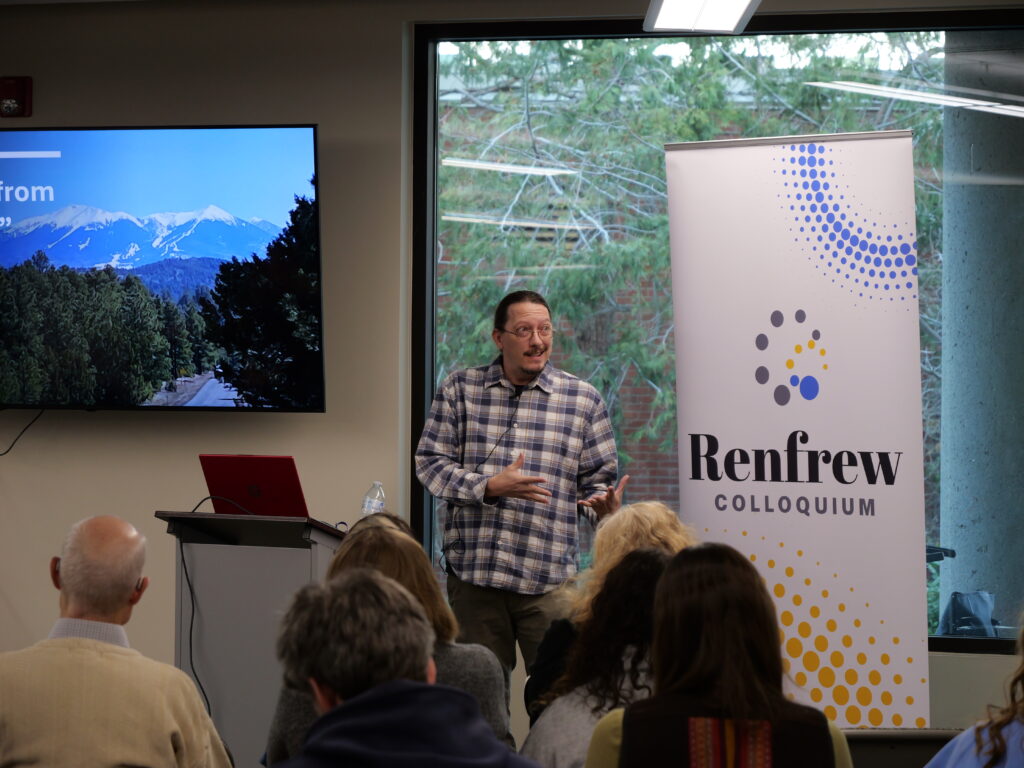
The San Francisco peaks in Arizona, which have a mediocre ski resort, according to William Holly, are the location at the heart of an on-going lawsuit between the 13 different Native American tribes in the region who consider the mountain sacred, the state of Arizona and the resort over the land.
Holly, a post-doctoral student in history and professor at the University of Idaho, presented his dissertation on “The Mountain is Part of Us: Tourism, Community, and American Indian Sacred Land in Northern Arizona” on Tuesday, Jan. 27, as part of the Renfrew Colloquium series.
Beginning the 1930’s, skiing became a popular past time for rich Americas and the peaks, home to the Arizona Snowbowl Ski Resort built in 1937, became a go-to destination in the four corners. Holly said Jacqueline Kennedy, wife of at-the-time presidential candidate John F. Kennedy, skied the mountain and told the press it was better than slopes in Aspen, Colorado. The nearby city of Flagstaff had also marketed themselves as the gateway to Indian country, notably holding powwows every fourth of July. While the snowfall was unreliable, according to Holly, the summer tourism of Flagstaff brought visitors year-round to the area, creating a major market demand for attraction and accommodation.
In 1969, Bruce Ledbetter, a Flagstaff local and developer, wanted to turn his land located at the bottom of Snowbowl, called Hart Prairie, into a resort that was planned to house 10,000 yearly residents. This land was an inholding, meaning it was a patch of private land surrounded by public land, which is what Holly said started the decades of lawsuit between the natives of the area, Bruce Ledbetter and the state.
Ledbetter was delayed starting his development because of the National Environmental Protection Act enacted January 1970, which required help to hold a public hearing and write an environmental impact statement.
Ledbetter was approved by the city, but during the public hearing in 1971, members of the Navajo and Hopi tribe got together to express their concern for the native sacred land.
This was “one of the first instances recorded where native American tribal members come to a public hearing and say you can’t do this,” said Holly.
Richard Wilson, who also owned land near Snowbowl, raised concern for the development of this land and teamed together with the natives to create lawsuits against Ledbetter’s development plans. In 1974, it was decided that nobody could build anything above an elevation of 8,000 feet. Hart Prairie stands at 8,500 feet above sea level.
In 1976, Ledbetter gave up on development of Hart Prairie property with subsequent
lawsuits between natives, the state and landowners of Hart Prairie following without a satisfactory ending.
In 2002, the resort decided they would make their own snow to increase the number of visitors to the mountain. This snow was being made of sewage water, which sparked a new fight from the natives who were upset that “poop water” was being spread all over sacred ground. The natives sued under the religious freedom act of 1993, and the lawsuit made it to the Ninth Circuit Court of Appeals, who ruled in favor of the tribe, though the decision was later reversed by a full court.
“The sole effect of the artificial snow is the plaintiff’s subjective spiritual experience. A government action that decreases the spirituality the fervor, or the satisfaction with which believer practices his religion is not what congress has labeled a substantial burden on that free exercise,” Holly said, citing the decision made by the court.
Snowbowl was required to use Class A+ reclaimed water to produce man-made snow, and was allowed to build two new lifts, 10 more trails and expand the lodge. The case was appealed to the U.S. Supreme Court on Jan. 5, 2009, but was denied.
After all these years of lawsuits and damaging relations between the state and the natives, Holly said the city of Flagstaff is now seeking help from the native communities following a series of large fires and monsoons that hit the mountain and caused billions of dollars in damage in 2022. Tribal members have suggested, according to Holly, co-management of the mountain, similar to Bears Ears in Utah and Ancestral Footprints of the Grand Canyon, but state officials have not entertained this partnership.
Emily Morales can be reached at [email protected].