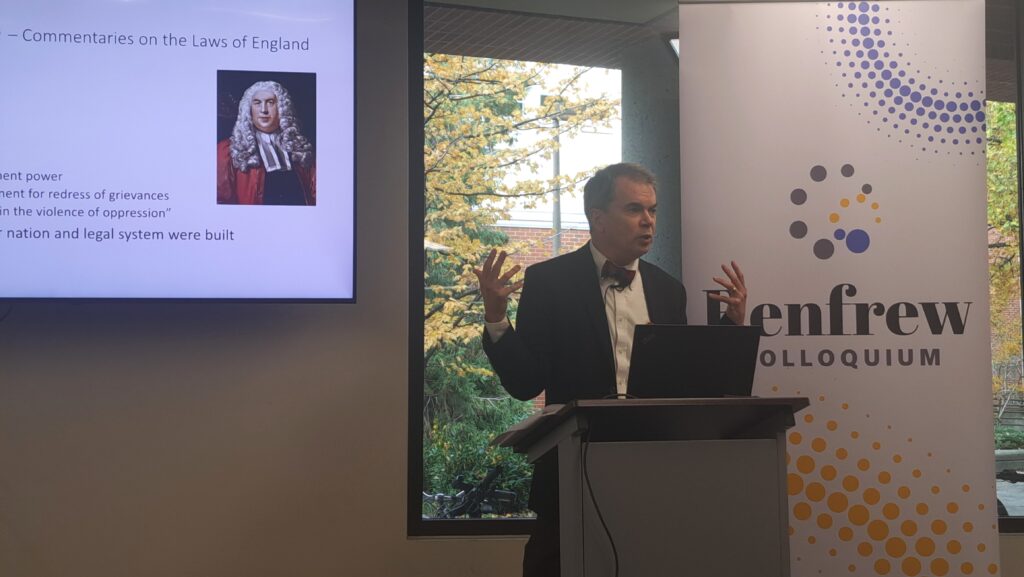
What do the blues and the rule of law have in common? Quite a bit, University of Idaho law professor David Pimentel argues.
At the Tuesday, Nov. 4, Malcolm Renfrew Interdisciplinary Colloquium, Pimentel discussed the two topics and how they interact in his presentation “The Blues and the Rule of Law: Musical Expressions of the Failure of Justice.”
While many see the United States as a pinnacle of liberty and justice for all, that notion may not be completely accurate. For Black Americans during the Civil Rights era, music was one way to communicate that.
Pimentel explained the rule of law as equal protection under the law for everyone. Certain rights, including security, liberty and private property, are fundamental.
Before he joined the College of Law as a professor in 2015, Pimentel led judicial reform and rule of law development projects in Bosnia and Herzegovina, Romania and South Sudan and worked with the United Nations at a war crimes tribunal in The Hague. His experience with rule of law reform has been “sensitive.”
“I’m working in post-colonial states, and when somebody comes from the United States or from western Europe and says, ‘Oh, we’re here to help you fix your legal system,’ it sounds a little bit like, ‘We’re here to civilize you savages’,” he said.
The United States’ own history with the rule of law is not necessarily something to brag about either, he said. While some argue that it’s under threat right now and some disagree with that, there have been many points in history when legal institutions did not uphold the rights of all Americans.

“It wasn’t that legal institutions were what protected Black America from injustice. Legal institutions were the very vehicles for injustice,” Pimentel said. “In a republic where the majority rules, the minority loses. … And we can’t expect majoritarian politics to produce justice for unpopular minorities, whether they’re political minorities or ethnic minorities or any kind of minority.”
The Dred Scott case and the Fugitive Slave Laws of the 19th century were weapons against Black Americans, he said. After the passage of the 13th and 15th Amendments, the Jim Crow era brought more of the same.
However, while one might expect violence as a way to fight back – and in some cases, that was true – it was music, not armed conflict, that resisted the violence of oppression.
The blues as a musical genre became a vehicle of lament for the Black community, communicating their experience with the failures of the legal system, which was able to change the mindset of the public.
The reason this worked, Pimentel said, is because freedom of speech is a difficult right to suppress, and music is even harder to suppress. In the Civil Rights era, many households had access to radios and music players, allowing the genre to spread and become more popular.
The genre was very popular, including among white audiences, those that often held more power in the legal and governmental institutions that could enact large-scale reforms.
“He’s singing about the injustice, right?” Pimentel said about Fats Waller’s jazz song “Black and Blue” (1929). “The idea is that ‘I’m black and blue. Why am I blue? It’s because I’m Black. It’s because I can’t get a break. And it’s because of the color of my skin.’”
Pimentel also played clips of Billie Holiday’s “Strange Fruit” (1939).
“It conjured … appalling images of lynchings. In the rule of law community, we call these extrajudicial killings … the killing of an individual without color of law happening through mob violence or through vigilantism, and it’s a threat to the rule of law everywhere,” Pimentel said about “Strange Fruit.”
Another example was Lead Belly’s “Midnight Special” (1934): “So, we see this story now, this story depicting … racial discrimination by law enforcement … itself, right? It’s not just that the law is standing by and letting these things happen. They’re actually making it happen, and that’s a problem,” Pimentel said.
“But this music reached white audiences. This music penetrated the white community. And as it penetrated the white community, it began to make a difference.”
He also mentioned Josh White’s “Uncle Sam Says” (1941), a World War II-era song about segregation in the U.S. army.
“The military wasn’t desegregated until after World War II, when Harry Truman did it, and it was so profoundly unpopular for his decision to do that, that the southern states bolted in 1948 and nominated their own candidate, Strom Thurmond, to run against him for president, because they were so frustrated that their Democratic president had stood up for equality in the U.S. military.”
These and other Black artists in the Civil Rights era became incredibly popular across the country, and many are still considered among the greats today. With the spread of the blues came the message imbued in each note.
“Everybody loves Louis Armstrong. White audiences fell all over themselves for Louis Armstrong. When Louis Armstrong sang ‘Black and Blue’, white audiences heard the song ‘Black and Blue’,” Pimentel said.
“Perhaps that message reached people, that the general lament of the Black community wasn’t being heard by the white community. It wasn’t being heard by legislators in Washington or by judges sitting on the bench. But when they started listening to this music, then the message started to get through.”
The rule of law came into play not only with legal reforms but also with freedom of speech.
“The path to reform, maybe it was sort of extrajudicial. It was on the outside. These people were not extra governmental, extra-legal, right? I mean, these were protesters. They were protesters in their music. That changed attitudes, and only after attitudes changed did the law change. It wasn’t a matter of the law fixing the problem. It was a matter of, the law was following, not leaving,” Pimentel said.
Pimentel believes that music as a form of protest, as a means of enacting change from outside the law, encouraged long-overdue changes in civil rights laws that continue into the modern day.
He finds today’s equivalent of the blues to be the hip-hop genre. Both frequently focus on social issues and injustices in America, particularly for the Black community, and both were similarly popular among all audiences. Many hip-hop artists have even sampled famous blues songs.
“I think the 21st century lament has more edge to it. There’s more anger in it. You don’t hear anger in ‘Black and Blue.’ You hear sadness. You hear discouragement, right? But here [in hip-hop] you get just a bit of defiance,” Pimentel said.
At the same time, hip-hop is a response to the blues; while the Civil Rights era may have changed things in the legal system, those changes may not have been equal on the ground.
In the end, the two genres have the same goal, Pimentel said: to change the cultural mindset. “[Laws] don’t get you very far if the public mindset is not sympathetic to that. How do you get the public mindset to come around? Music can be enormously influential.”
“Maybe the blues helped bring about justice in a way that the legal system never could,” Pimentel said. “Will hip-hop advance the rule of law further? Well, maybe so. And maybe this is our best hope for affecting future and overdue social change.”
The next Renfrew Colloquium presentation will be hosted by Scott Nuismer, a professor of biological sciences. Nuismer will discuss climate change’s effect on the spread of diseases in “Stopping Spillover Before It Occurs: Insights from Mathematical Models and Lassa Virus” on Tuesday, Nov. 11.
The Malcolm Renfrew Interdisciplinary Colloquium began in 2001 and is sponsored by the College of Letters, Arts and Social Sciences and the UI Library. Presentations are hosted weekly on Tuesdays from 12:30-1:30 p.m. on the first floor of the library.
For more information on the Renfrew Colloquium and the semester schedule, visit ww.uidaho.edu/letters-arts-social-sciences/news-events/renfrew-colloquium.
Dakota Steffen can be reached at [email protected].