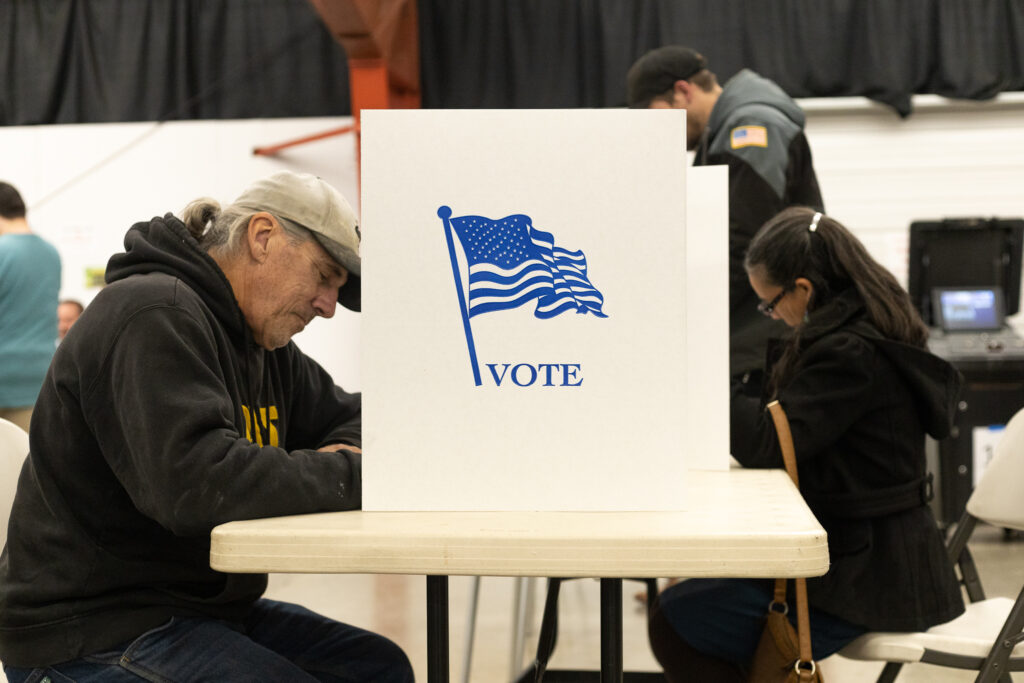
While presidential elections happen only every four years, local elections occur every year, whether the poll is for city officials, bond or levy measures or county officials. A general election for the city of Moscow, as well as almost every county in the state, is planned for Tuesday, Nov. 4, with candidates this year running for city council positions and the mayor of Moscow.
All of these smaller-scale positions — mayor, city council members, county commissioners — have a direct impact on the lives of the citizens of Moscow. The city’s mayor is in charge of budget oversight and community development, city council members create ordinances and rules that govern the city, and the county commissioners set the county’s property taxes, fund the public defender’s office and manage county-owned property.
Despite this, local election voter turnout is only around 20% of registered voters, according to the Center for Effective Government at the University of Chicago, while the total voter turnout for the 2024 presidential election was approximately 60%, according to The American Presidency Project. What is the discrepancy between these elections that leads to such a low turnout for the one that arguably has more impact on day-to-day life?
There seems to be an undercurrent of indifference in local elections, with the phrase, “My vote doesn’t matter,” or something similar, nonchalantly thrown out as a reason. This belief is strongest in young voters, with PBS News reporting that young people are far less likely to care about politics, with many claiming that voting has no value.
Research around local elections suggests that the lower turnout rates could be a result of lack of awareness of the candidates and a lack of understanding of what roles the elected officials play, according to the National Civic League.
However, voting in local elections and passing legislation that protects these governments “is vital to ensure Americans have a representative local government that responds to their needs,” according to the League of Women Voters. The people voting into local government positions “have a direct hand in dictating the operations of everyday life,” according to The Independent Florida Alligator.
“There is a common misconception that due to ‘so many’ people voting, a singular vote cannot change the course of an election. This too is false,” The Alligator wrote. With local elections having less voters overall than a presidential election, ballot gaps between candidates will be undeniably smaller, meaning that it would require a fewer number of votes to upset a race. This highlights the great importance of these elections.

“Participating in elections is one of the key freedoms of American life. It is the only way in a Representative Democracy to ensure each voter’s voice has meaning,” Joy Cowdery, a member of Living Democracy: Engaging Citizens, wrote in The Marietta Times. “The need to reach youthful voters is vital. As the campaign season for the 2024 election gets into full swing, many young voters — meaning people under 30 — say they’re disillusioned with politics and plan to sit out. This needs to change.”
Throughout history, Americans have seen the importance of voting displayed in various races with outcomes determined by only one or two votes. In 1800, Thomas Jefferson became president by one vote. In 1876, Rutherford B. Hayes was elected president, winning by one vote. In 1920, it was one deciding vote, from a Tennessee legislator, that ratified the 19th Amendment and gave women the right to vote.
And now, voting is easier than ever. There are states with more accessible early voting systems, and the option of mail-in ballots means voters don’t even need to leave their houses. Idaho is one of the states that allows early in-person voting and mail voting for all citizens, according to NPR.
This logically should lead to a higher voter turnout, but U.S. Census Bureau data still shows that America is experiencing an overall decreasing turnout since the early 1900s. In the face of declining numbers, Americans should continue to champion the deeper meaning of voting: being heard, being counted and being respected.
“You’re voting for yourself basically to have the dignity of having your issues being considered and whether you win or lose, people listen to your voice and they hear you,” Shirley Weber, California Secretary of State, told NPR.
Voting is what defines democracy; voting makes America, America. Our system of government that the founding fathers fought tooth and nail to obtain sits on the very foundation of electing officials, instead of the scepter simply being passed down. Should we abstain from participating in elections, on all levels, we are only allowing others to make decisions for us, leading to political consequences.
The Editorial Board can be reached at [email protected].