
James Gibb was a phenomenal football player for Idaho from 1899-1901. He led the team as captain in 1901 and brought the Vandals key wins.
James Gibb was a multi-sport athlete with his brother, William Gibb. They played both football and baseball together.
James Gibb, nicknamed “Buck,” was a stud in football and was impactful for the history of the University of Idaho program. He was announced captain of the football team in 1901. He started playing for the Vandals in 1899, and his brother William Gibb joined him as well. James Gibb was a left halfback, which was equivalent to the current term of a running back.
Back in the 1900s, there was no forward pass, and the halfback was the player getting the ball most of the time. James Gibb ran either through the line or around the linebackers in dangerous styles of play. Football was very dangerous and this caused a lot of tactics to get banned.
Football gear during the turn of the 20th century was very primitive and had little protection compared to today.
Idaho played teams locally, and the furthest they ever went was Seattle. A neutral location was used for the 1900 Washington game, which was in Spokane.
Idaho won the game 12-6. James Gibb was called the “bright particular star” in the 1899 game versus Lewiston by The Argonaut. In one of his “mad dashes” in that game, he “received a slight tap on the head rendering him temporarily insane.” He was then subbed out.

The Idaho 1901 team, which James Gibb captained, was led by Head Coach Fred Herbold. Idaho went 3-2-1 that year. James Gibb was a key player in Idaho history as he led Idaho to their first victory over Washington Agricultural College—now Washington State University—cementing his legacy as a Vandal.
Idaho also tied with Oregon, and lost to Washington after beating them the previous year. Now, Washington and Oregon are massive teams with millions of fans. In 1901, The Argonaut said “Captain Gibb had good control of his men at all times.” James Gibb displayed his leadership and natural ability, proving why he was captain of the team.
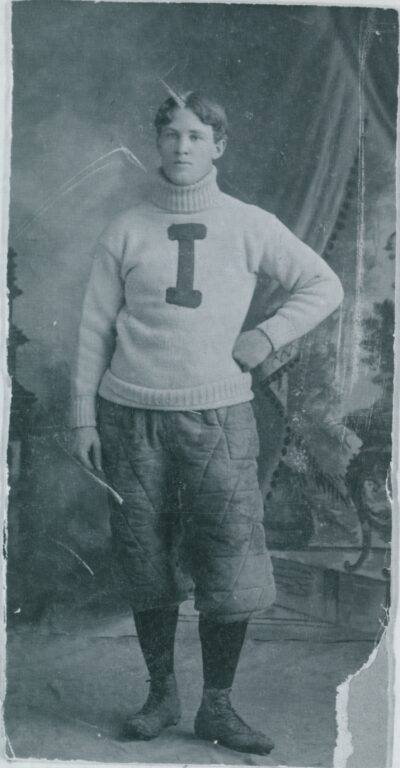
The great nephew of James Gibb, Curtis Hermann, was very insightful on much of what he knew about his great uncle from the 29 years James Gibb was alive. Starting at Moscow Preparatory School along with his brother William Gibb and sister Mary Gibb, he chose the UI ROTC program in 1897.
“James’ father, in 1878, homesteaded ground south, 10 miles southeast of Genesee…that is about 50 miles from Moscow,” Hermann said in a Zoom interview. The family owned a plot of land in Moscow that they would live on in the winter, which is what started James Gibb’s commitment to go to UI.
James Gibb, shortly after enlisting into the ROTC, decided to volunteer for the Spanish-American war, in which he was one of the first volunteers. He enlisted at 5’9”, 152 pounds and was 21 years old.
“[When James Gibb] was shipped out, he got the mumps, and so he and Jim McClure came back to Idaho, where they both became football members,” Hermann said. Shortly after, they were moved from the San Francisco unit to the South Dakota unit. James Gibb was a part of the Old Guard and was shipped off on the Rio De Janeiro.
The unit saw the opening phases of the Philippine-American War, and James Gibb was thrust into action. He fought before getting wounded in action on April 25, 1899.
“He had a cup that was attached to his knapsack, and the bullet went through his cup and through his shoulder,” Hermann said. He was discharged at Presidio, San Francisco. James Gibb’s story made such an impact that it created a deliberation of whether students should be sent to the war.
In 1902, James Gibb graduated with a Bachelor of Sciences from the mining department. After graduation, he accepted a job with Hercules Metals mining company to become an assayer, where he gained the reputation of being one of the best in his profession.
Jerome Day of the mining company stated that his company couldn’t run without James Gibb. In 1907, James Gibb was elected president of the UI Alumni Board, where he served until 1908.
In 1909, James Gibb became unexpectedly sick, and it was discovered he had an aggressive form of appendicitis. Despite operation, James Gibb succumbed to appendicitis, dying unexpectedly at age 29 in the Gritman Medical Center in Moscow.
Timmon Friel can be reached at [email protected].
Bart Jacquinet can be reached at [email protected].
PAMELA LEBLEU
Very interesting story. Great background information.