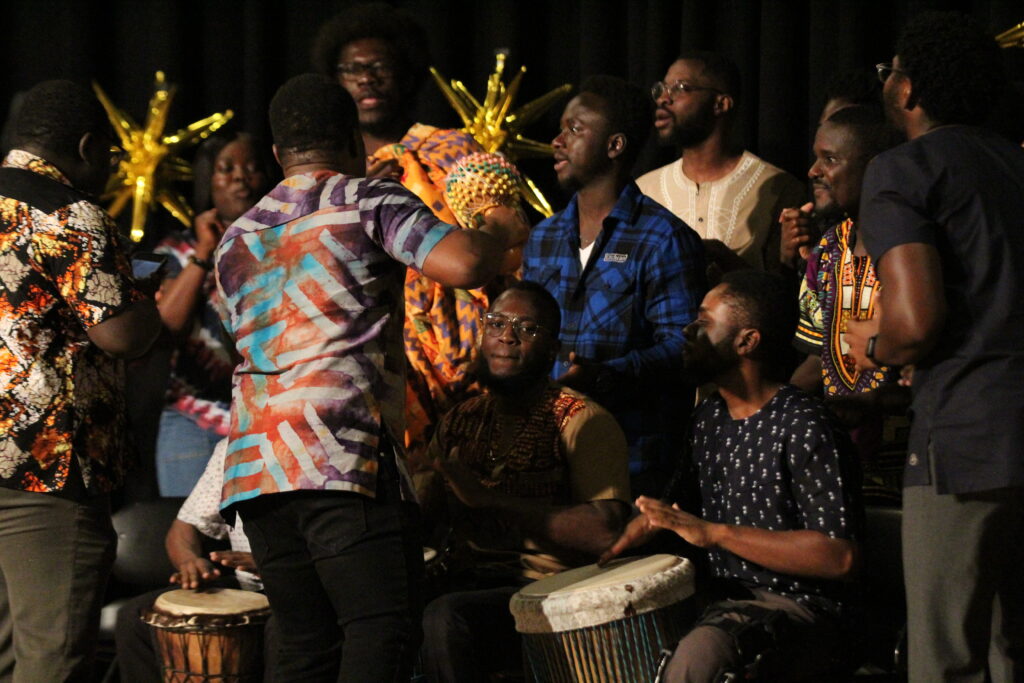
On Saturday, Oct. 4, the African Student Association held the annual Africa Night event at the International Ballroom in the Bruce M. Pitman Center. Emcee Ronald Bentil, a third year Ph. D. candidate in entomology at the University of Idaho, welcomed guests, ensured every child in the audience had coloring pages and introduced the ASA president and UI graduate research assistant, Listowell Darko. Darko donned an orange traditional Ghanaian kente wrap over his shoulder. He prompted the audience to open their “hearts to the rhythm, colors and tastes of Africa” and promoted the night’s theme: Wazobia.
“Wazobia” is a combination of the word meaning “come” in three African languages, “wa” in Yoruba, “zo” in Hausa and “bia” in Igbo. It was first used by Nigerian radio broadcasters in the 1970s to appeal to the country’s three main ethnic/language groups. Now, it is a term that symbolizes community and diversity. Each time Bentil called out “wazobia” the audience responded in turn, “I am because we are.”
The meaning of this was explained by ASUI president and member of the ASA, Seyi Arogundade. “Our strength is in our unity,” she said. She emphasized that “community will create long lasting effects.” Arogundade was followed by keynote speaker Dr. Dora Mtui, the laboratory services manager at the UI College of Natural Resources. Mtui called Africa Night “a night to showcase how great Mama Africa is.” She chronicled her experience moving from Tanzania to the U.S. as a student and encouraged other international students to create community and seek out resources. Mtui stressed the importance of fighting for the future of the African continent and shared an adage from her father that emphasized the importance of community. “If you going to go fast, go alone. If you going to go far, go together.”
Following Mtui’s remarks was the flag parade. Students from 20 African and Caribbean countries waved their flags as Bentil presented a slideshow highlighting population, number of languages and historical kingdoms of each state. At the end, every participant held their flags on the stage in a powerful display of strength in diversity. As food was served, a great array of dishes from across the African continent from Ghanaian hibiscus juice sobolo to the Nigerian egusi stew made with melon seed, goat meat and mackerel, Kwesi Asare recited a poem. His performance was emotional and promoted pride in African heritage. “Let our stories be heard, let our presence be felt,” he said.
The Washington State University Krimson Kouture dancers in blue pattered wrap skirts preceded the jàmá music and dance performance. A jubilant chorus of a dozen men, among them Bentil and Darko, sang a call and response song with such authenticity and pride that attendees spontaneously joined them on stage for a heavily layered performance of chanting, singing and drumming that lasted over fifteen minutes.
Immediately after, the ASA honored three members for their commitment to the association: Sodiq Yusuf, Bentil and Olugbenga Gideon. Gideon, in a purple patterned Nigerian Ankara, shared his gratitude for the opportunity “to share the culture of the huge continent of Africa with our hosts” in Moscow.
Professor Romuald Afatchao gave closing remarks, noting the African community is “here in Moscow as a family.” Bentil followed him sharing a translation of a Ghanaian adage, “when an elderly man speaks, the matter is finished.” The room was turned into an open dance floor until the end of the event.
Miriam Moore can be reached at [email protected]