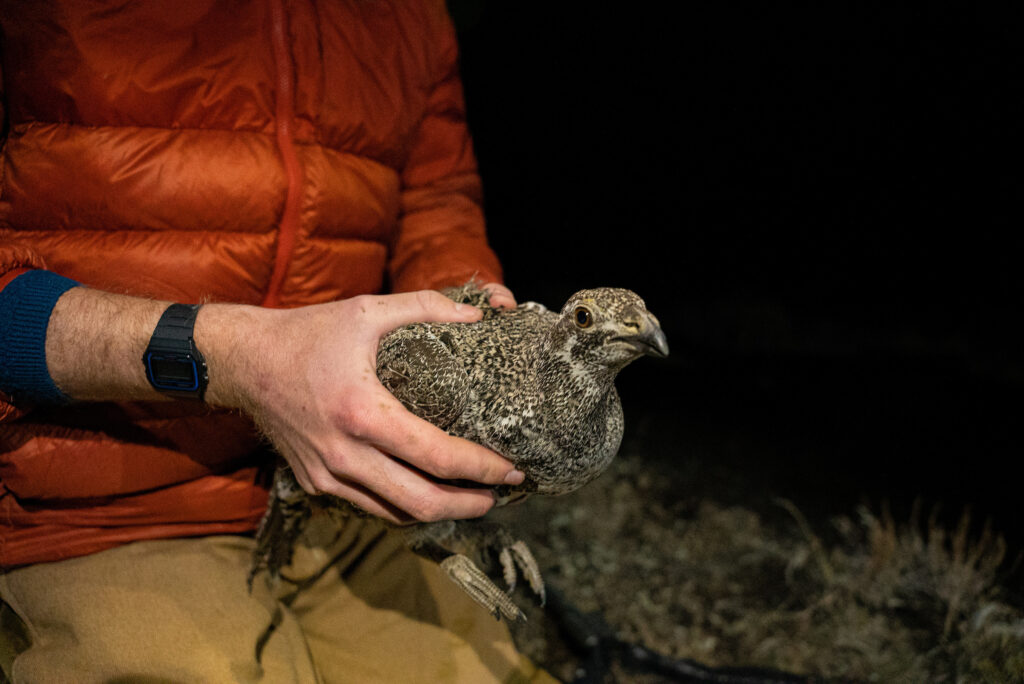
Moderate cattle grazing on public land does not reduce sage-grouse nest success, according to a newly published 10-year study led by a University of Idaho professor.
The value of well-researched policy was reinforced this month with the publication, which addressed an issue of previous concern in ecological policy. The study was sparked by early 2000s opposition to spring cattle grazing on federal land, a claim with little science to inform the debate on either side. Now, after a decade of research concluded in August of 2023, the full study has been made publicly available online.
The findings demonstrate how sage-grouse and cows can coexist on southern Idaho land. In a statement to UI, project lead Courtney Conway, a UI professor of wildlife sciences and leader of the U.S. Geological Survey Idaho Cooperative Fish and Wildlife Research Unit, said, “Nesting success and insect biomass don’t seem to be affected by low to moderate levels of cattle grazing.”
An exceptional amount of time and energy was put into this study; sage-grouse were observed for two years prior to manipulation of surrounding grazing, with the complete study wrapping after a decade of research.
“Decisions regarding sage-grouse and cattle were being made by land managers, but there wasn’t a lot of science to rely on,” Conway said. “We just didn’t know what effect spring grazing had on nesting sage-grouse, brood production or other vital rates, until now.”
This decade of research was done in collaboration with UI professor of rangeland ecology Karen Launchbaugh. “Courtney is one of the greatest scientists and collaborators I’ve ever worked with,” she told The Argonaut. “There’s no doubt … he puts the goal of the research and the good of everyone there well above himself.”
This project is notable not only for its yields but also as a landmark study regarding outside collaboration. Conway and Launchbaugh worked with 18 separate organizations in order to complete this research, a process that Launchbaugh described as difficult. Keeping so many separate organizations in the loop took an unprecedented level of communication.

“This was truly interdisciplinary,” Launchbaugh said. “There’s nobody on the team that knows everything about this project. We all brought our piece to the table and then we were able to put the puzzle together.”
Some of the groups involved were the UI Rangeland Center, U.S. Bureau of Land Management and the Idaho Department of Fish and Game, showing just how broadly the project spanned.
For ten years, Conway’s researchers collected and analyzed data annually from five sites in the state, observing any effects of grazing levels on sage-grouse nesting and brood rearing. They specifically looked at the currently permitted low to moderate grazing levels, though more demanding grazing may yield different results.
In UI’s press release, co-lead investigator Launchbaugh confirmed, “We now have rigorous scientific results to support the idea that cattle and sage-grouse can co-exist under the scenarios we examined. These findings suggest that responsible public land grazing can continue without harming sage-grouse.”
“What I’m really proud of is that I think we really showed that grazing is compatible with grouse, and that is really important,” Launchbaugh said. “If there are still declining sage grouse populations, it means we’ve got to look somewhere else [where] cows are not the problem. So let’s not spend our energy on a lot of plans and changing the way grazing is done. Let’s focus on the things that are obviously important.”
“Most people assumed that cattle grazing would be bad for grouse … The biggest [reason] is that the successful nests have taller grass around them than unsuccessful nests and cows reduce grass height,” she said. “So there have been policies for 20 years, grazing policies at the federal level, saying, you’ve got to remove the cows because they’re reducing grass height, which will affect the grouse. And we found out that’s not true. Cows do reduce grass height, but it’s not affecting the success of nests.”
These findings are especially significant in modern policy debates. Rather than relying on assumptions when making decisions at the state and federal levels, it’s evident that research-backed science is still essential to make informed decisions in the world of policy, environmental or otherwise. Looks can be deceiving and it takes thorough research to prove it.
Launchbaugh emphasized the importance of continuing research as well. “We have to remember that we haven’t done all of the science. The things that we do today, someone may prove them wrong tomorrow … We just can’t assume that what we knew 20 years ago or 30 years ago is true.”
The study ultimately involved more than 1,300 radio-collared sage-grouse hens across five research sites with 1,285 nests documented and 399 broods tracked. The research area spanned 29,000 acres to comprehensively investigate and determine the effects, or lack thereof, of spring cattle grazing on the birds’ population in the concluded study. Further details are available on the project’s website.
Julia Kolman can be reached at [email protected].