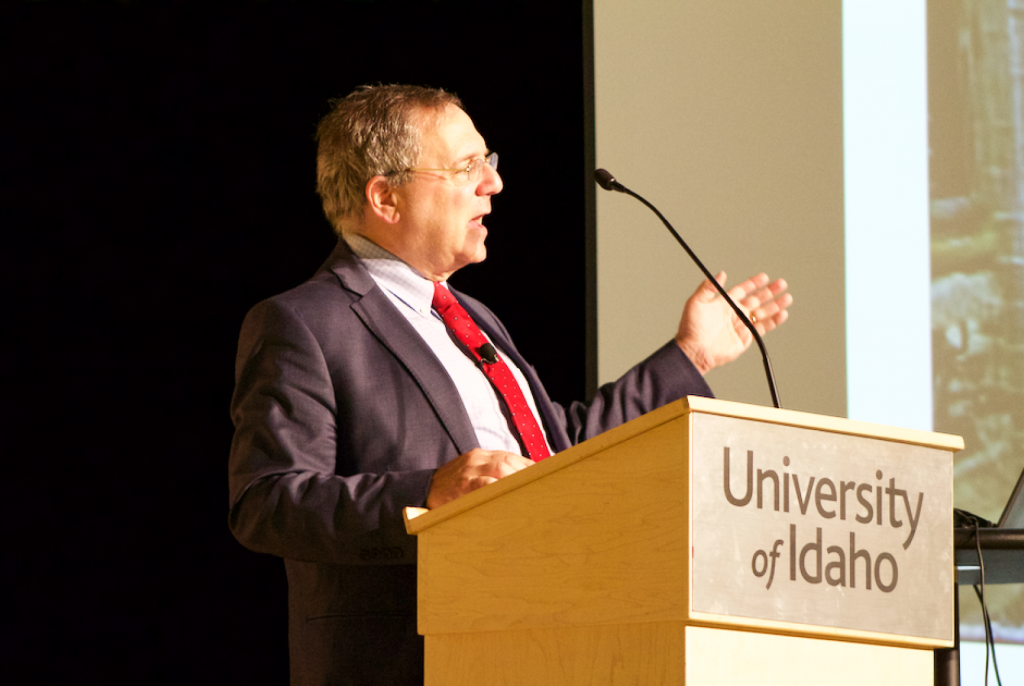
In his keynote address Monday, Borah Symposium speaker and New York Times national security reporter David Sanger compared Russia interference in the 2016 election to Nixon’s Watergate scandal.
Instead of physically breaking into a room and looting through a single file cabinet, however, the Russians hacked into the Democratic National Convention’s server, which contains much more information than the file cabinets did.
In both cases, the significance of the event was not the specific information accessed by the infiltrators, but the fact that the security breach happened in the first place. At this point in the development of cyber weaponry, hackers can access systems remotely from across the planet and find information, alter data, or cause physical destruction.
“We have to have this humility of understanding that right now in the world of cyber, we’re somewhere around the end of World War One,” said Sanger in his address. “We’ve seen skirmishes fought with these weapons… We know that it can be weaponized. We don’t know what those weapons will look like or what they will be capable of.”
Sanger’s address lasted an hour, followed by a half hour long question and answer session and a book signing for his new book The Perfect Weapon: War, Sabotage, and Fear in the Cyber Age. Sanger covered the history of how technology has been used in war and how the cyber age changes the relationship between technology and warfare. This year’s symposium tackles “Pax Technologica”, or “peace through technology” and will examine modern technology through a political lens.
Sanger opened his address by discussing William Borah, the namesake of the symposium and University of Idaho’s Borah Theater.
“Borah was a fascinating and incredibly contradictory character,” Sanger said. “He was a huge figure in what, in my mind, is the most critical formative years of the United State. … This lecture is rooted in another one of Borah’s interests, which is keeping the United States in peace.”

Sanger transitioned into discussing modern technology and its role in warfare by comparing how Borah’s interests relate to modern goals of “keeping the United States in peace.” State and non-state actors have learned how to control cyber tools and weaponry like any other method of social control they utilize or have utilized, Sanger said.
He referenced current events often throughout the address, including the Kavanaugh case and the Russia investigation. The Russia investigation’s significance as an example of cyber warfare played a key role in the address.
Sanger reminded the audience that cyberattacks have only been a major national safety concern for the past five years according to the Worldwide Threat Assessment. Several major attacks have occurred in recent times, few of them widely known; Stuxnet, Saudi Aramco, Dark Seoul, Sands Casino, and Sony Entertainment name a few of them.
Sanger ended his address by warning the audience that the problem will only get worse in the future. Countries can no longer defeat the “perfect weapon” by building new weapons.
Instead, countries must rely on enhancing cyber security and finding political solutions that do not involve treaties. We as a global community must decide how we will bring stability to cyberspace.
The next Borah Symposium events will be the Renfrew Colloquium on Gaming for Peace in the Vandal Ballroom at 12:30pm Tuesday and the Closing Keynote Address by Jane McGonigal in the International Ballroom at 7:00pm Wednesday.