The tentative tuition and fee rates at the University of Idaho for the 2026-27 academic year have been published and will be presented to the State Board of Education on April 15-16. Until then, students, staff and faculty are welcome to provide feedback, beginning with an open forum on Thursday, March 26, at 3:30 p.m. in the Clearwater/Whitewater Room in the ISUB.
The university community can also provide feedback by emailing [email protected] or by contacting Trina Bower, vice president of University Budget and Planning, at [email protected] or (208) 885-4387.
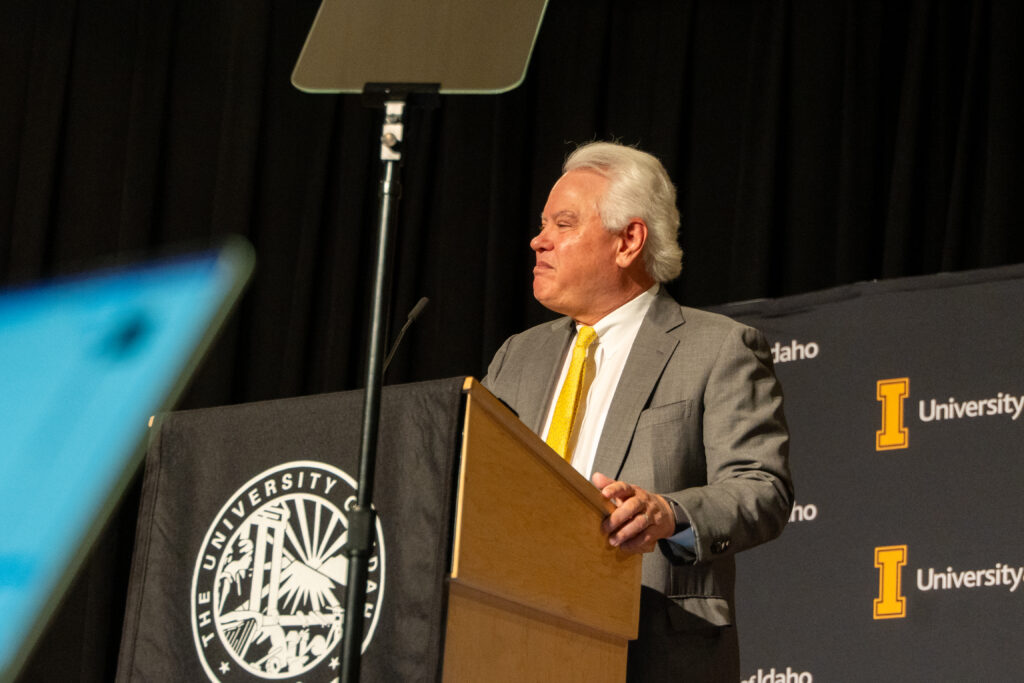
In the initial notice, Green primarily addressed the proposed tuition increase, explaining it will be necessary to address rising costs driven by inflation, including expenses related to information technology, utilities and health benefits, while also supporting sustainable institutional growth.
For full-time undergraduate students, resident tuition would increase from $3,514 to $3,738 per semester; non-resident tuition would increase from $13,132 to $13,356 per semester; and Western Undergraduate Exchange tuition would increase from $5,271 to $5,607 per semester. For part-time undergraduate students, resident tuition would increase from $418 to $440 per credit, and non-resident tuition would increase from $1,380 to $1,402 per credit.
Graduate full-time rates would increase from $4,380 to $4,604 per semester for residents and from $13,998 to $14,222 per semester for non-residents. Part-time graduate rates would increase from $566 to $591 per credit for residents and from $1,635 to $1,660 per credit for non-residents.
Green also highlighted an activity fee increase for the Counseling and Mental Health Center, which is expected to generate approximately $200,000 for the department.
The consolidated mandatory fee would increase from $1,186 to $1,198 per semester for full-time students, while the part-time student fee of $52 would not change. The fee covers Student Enrollment, Engagement and Success ($140.89); Institutional Operations, Services and Support ($756.50); Student Health and Wellness ($227.55); Student Government ($68.73); and the optional portion of the Student Government fee ($4.33).

Professional fees, which include doctor of psychology, direct-entry master of science in nursing, art and architecture and law programs, are not projected to change. Certain program fees, which are paid instead of regular tuition, are projected to increase, while others will decrease slightly. Most of these program fees will not change.
Representatives from ASUI, the Student Bar Association of the College of Law and the Graduate and Professional Student Association all participated in the student fee recommendation process, beginning in January. The seven members of the dedicated student fee committee reviewed proposals from various units around campus for new or increased activity fees
The dedicated student fee committee, made up of seven student leaders from ASUI, the Student Bar Association of the College of Law and the Graduate and Professional Student Association, voted on proposals for new or increased activity fees before providing a recommendation to Green.
This year’s committee included Seyi Arogundade, ASUI president; Bryant Sitts, ASUI vice president; Kyra Humbert, a representative for the SBA; Gunner Cavener, an ASUI senator; Alma Azocar Agurto, ASUI director of legislative affairs; Zachary Foley, chair of initiatives for GPSA; and Phillip Hagen, president of GPSA.
For more information on student tuition and fees, visit the Budget and Planning site on Inside UI.
Dakota Steffen can be reached at [email protected].