The ongoing war in Iran is unlikely to result in a regime change, according to a University of Idaho professor.
Professor of global studies Erin Damman said that a complete democratic change in Iran would be very difficult to pull off, since most of the legislative leaders are aligned with the former supreme leader Ayatollah Ali Khamenei, keeping his belief system relevant in the country.
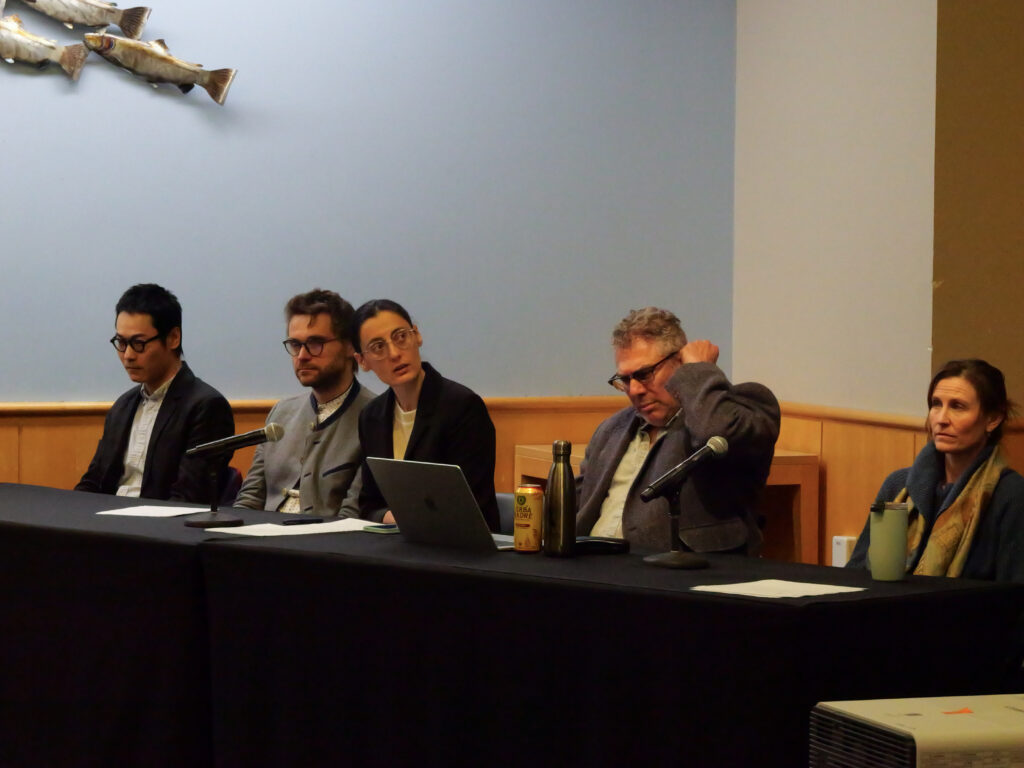
Professors from the University of Idaho Martin Institute and the Department of Politics and Philosophy held an expert panel on the on-going war in Iran, on Tuesday, March 10. The Iran Pannel discussion was held in person, and live-streamed, with about 50 students in attendance.
The United States and Israel started airstrikes in the early hours of Saturday, Feb. 28. Since then, thousands of strikes have hit targets such as military bases, the Shajarah Tayyebeh girls school, which killed 175 people, and Khamenei’s compound, killing Ayatollah.
“As [Iran’s] proxies have faced heavy military defeats…showing weakness in its foreign policy abilities… Iran has been facing some serious challenges to its regime from a both domestic and international stance,” said Damman, who opened the panel.
President Donald Trump announced the current attacks known as “OPERATION EPIC FURY”, in a pre-recorded video posted to his Truth Social account at 4 a.m. on Feb. 28
“They have had every opportunity to renounce their nuclear ambitions, and we can’t take it anymore. Instead, they attempted to rebuild their nuclear and to continue developing long range missiles,” Trump said in the video.
Professor Chen Wang, the Slayton assistant professor of East Asian Politics, was given the perspective of U.S. considerations. Wang spoke on how almost every U.S president since Jimmy Carter prefers a regime change over other sorts of diplomacy. He attributed this to the consistent conflict between the U.S. and Iran, as well as the way the Iranian regimes seem to resist western presence and interests.
“These was something that has not been really mentioned by news coverage, which is the uniqueness of Trump’s position in the U.S. presidential electoral cycle.” Wang said. “Research shows that American presidents who are early in their tenure are way more likely to get involved in conflict, than at any other time during their tenure,”
China and Russia are hesitant to speak against the U.S. actions in Iran, Wang said. The response these counties had was less vocal than their response to condemn U.S. action after the capture of Venezuelan president Nicolás Maduro in early January.
Beijing is handling its foreign policy with the U.S. very well, and Moscow is currently pre-occupied in war with Ukraine, Wang said.
Adjunct Professor Emine Ari-Erol spoke on the implications and reactions from the ‘gulf countries’, and the region surrounding Iran. Most Gulf countries are focusing on protecting civilian infrastructure, including spaces such as luxury hotels, AI centers, and airports, to maintain the status of a safe global center that is open for trade, business and tourism.
“By Saturday, [March 8] at least 14 countries were directly affected. This war is not anymore between Iran, the U.S. and Isreal, because Iran is deliberately targeting the U.S. partners in the Gulf, and treating them as co-belligerents to maximize the cost of the campaign,” Ari-Erol said.
Ari-Erol also spoke on how Palestine is the ‘most tragic case’ due to it losing global attention, and its largest ally, Iran.
“International Aid is frozen, and Israel has shut down entries and exits in and out of Gaza,” Ari-Erol said.
Department of Politics and Philosophy Chair and Director of Graduate Studies, Florian Justwan introduced perspectives from U.S. Allies, especially those from the EU and Israel.
“If you look at the official language from prime minister Netanyahu, you’ll hear that Israel says it was a pre-emptive strike in order to remove threats against Isreal, that we may call this an instance of strategic overstatement,” Justwan said.
He added that most leaders in the EU were concerned about what this attack says about U.S. intentions in the area but are publicly silent or threading the needle due to the U.S. assistance in the ongoing war in Ukraine.
“Privately, they are pretty unhappy about the conflicts; they are unhappy that they haven’t been looped in, and they do have concerns about the legality of this war,” Justwan said.
The final panel speaker, Clinical Assistant Professor of Political Science, Charles Dainoff, spoke on what the next steps were for the war.
Dainoff placed the timeline of the remainder of the war from now to summer 2026.
“The global economy has become more volatile than before as we see the weakening of institutions and the solution of formerly solid alliances,” Dainoff said.
Dainoff continued to go through scenarios, stating that the most likely one is that Mojtaba Khamenei, the son of the previous Ayatollah, will continue to act in Iran as his father did, with religious and political crackdowns. Iranians will die as a result, Dainoff said. He also added that the U.S will end the military campaign relatively soon, and “move on to the next shiny object” as the rest of the region continues to fight each other for political dominance.
The Argonaut interviewed Tadman Nettles, a freshman political science and philosophy major.
“I think it is important to listen what academics actually have to say… I think everyone should go to it, regardless of if they are a political science major, engineering major, people should also ask questions,” Nettles said.
The Argonaut also interviewed Mila Rice, a Political Science senior, who was interested in the panel both academically and personally.
“I wanted to see a more overarching discussion that kind of covered every element as it appears,” Rice said.
The UI martin institute works to promote deeper understanding of war causes, necessary conditions for peace, and international engagement. The institute holds lectures and panel discussions in conjunction with the Department of Politics and Philosophy, as well as lectures on international topics.
Josie Adjanohoun can be reached at [email protected].
Dennis Whitehead
Thank you for your informative article!