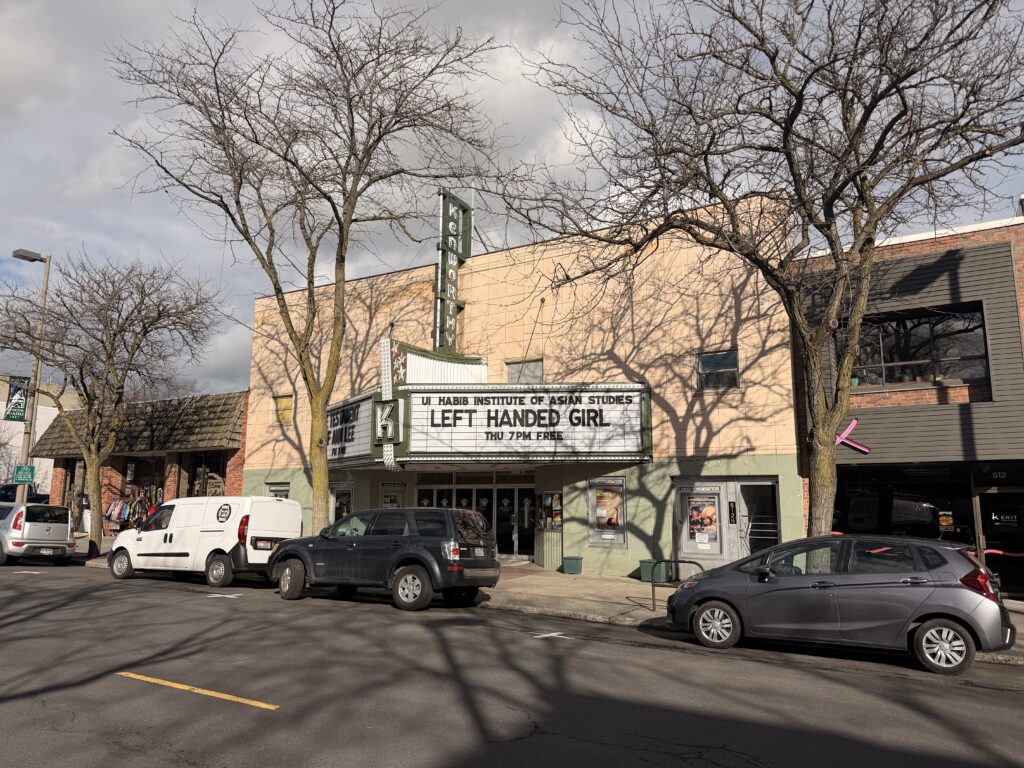
“Left-Handed Girl,” a 2025 Taiwanese film and directorial debut for Shih-Ching Tsou, was shown at the Kenworthy Theatre in partnership with the University of Idaho Habib Institute of Asian Studies on Thursday, March 5, as their final event for the Chinese New Year.
“Left-Handed Girl” is a fantastic movie that expertly plays with the split between traditionalism and the modernization of younger generations. The film was both funny and emotionally impactful throughout its entirety. The story centers around three main characters: Shu-Fen, the mother, Yi-Ann, the eldest daughter, and Yi-Jing, the youngest daughter. Each generation of the family has their own perceptions of traditions and folklore which is thoroughly explored throughout the movie.
Shu-Fen has an abusive ex-husband who has become terminally ill and faces financial hardship to pay for his medical and funeral bills burdened by obligation. Yi-Ann has a turbulent relationship with her mother made worse by the debt accrued paying for her father’s expenses and works the stigmatized job of selling psychedelics, while Yi-Jing struggles with her left-handedness in a culture that is both growingly excepting of left handedness but still retains much of the stigma within older generations.
At one hour and 48 minutes in run time, “Left-Handed Girl” was entirely shot on an iPhone camera in Taipei, Taiwan. This choice of filming technique and the limited focal length of the lens keeps the camera close to characters and also shows the world in the way people document their life rather than what can be seen on a movie set seen though a cinema camera.
In one of the opening scenes, Ama, the grandmother, Apa, the grandfather, Shu-Fen, Yi-Ann and Yi-Jing are eating together. Yi-Jing is eating with her left hand, as is normal for around 10% of the population, yet Apa looks at Yi-Jing and questions her actions.
Ama tells Apa that nobody follows those old rules anymore. In traditional Chinese and Taiwanese culture, the left hand is associated with the devil, Apa tells Yi-Jing when they are alone.
Jeff Kyong-McClain, the director of the Habib Institute for Asian Studies and associate professor of history at UI, gave an opening talk before the movies showing where he used the central line of left-handedness to explain the cultural struggles expressed in the movie that do not have parallels in the United States.

Most of the films cast members are women, and the few men that are shown have major character deficits with very little redeeming qualities from what is presented. The centrality of women is a comment on the shame and standards sexist placed on them by their culture, especially from within their family. Another core theme is the one-sided shame placed on women expressing their sexuality.
For example, when two boys learn about Yi-Ann’s job, they ask her how much to touch her, 100 or 200. Her job implies the character of her and her family.
However, what people observe in Yi-Jings devil’s hand and Yi-Ann’s stigmatized work turn out to be true. Yi-Jing steals from her grandmother and Yi-Ann is revealed to have had an affair with her boss resulting in pregnancy. When this comes to light, the grandparents are outraged, yet it is cathartic for the younger generations to be honest about the people they are.
These examples represent the changing cultural mindset where younger generations push though tradition rather than live a life restricted by it. At the same time, the lessons persevered in tradition are not to be forgotten.
The showing at the Kenworthy was a one-time event, but the film can still be watched on Netflix in Mandarin with English subtitles.
Dale Fussell can be reached at [email protected]