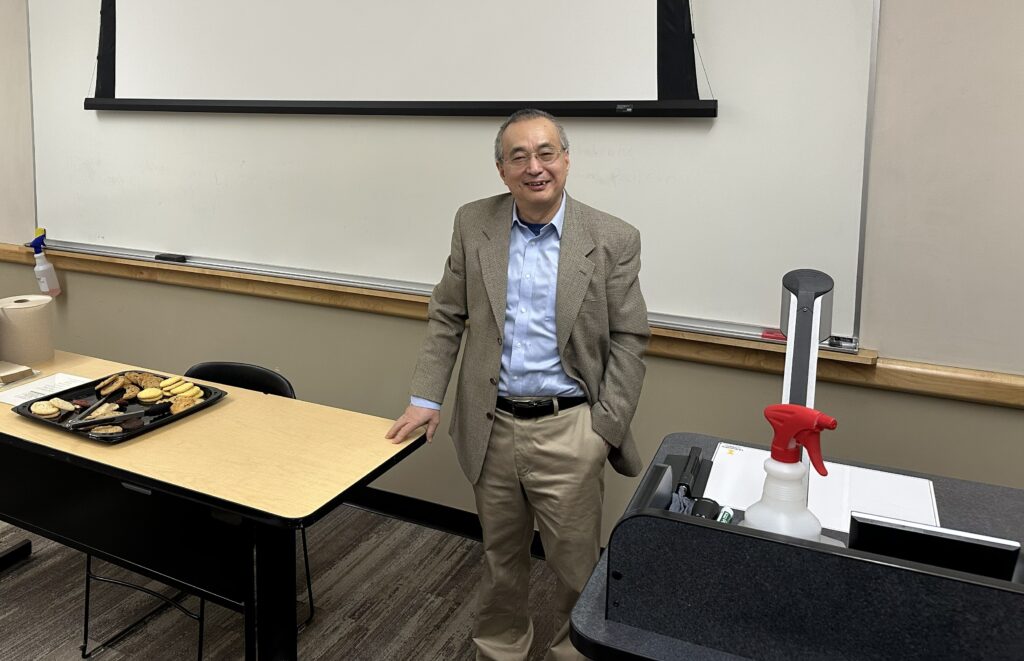
Ancient Chinese cosmology developed from careful astronomical observation rather than myth alone, said University of Idaho physics professor You Qiang, who spoke on the topic at a brown bag talk on Feb. 26 presented by the Habib Institute for Asian Studies. The event aimed to highlight work being done in Asian Studies by UI researchers and was given a week after the start of the 2026 Chinese New Year.
According to Qiang, early scholars observed the gradual change of light throughout the year from long and bright days during the summer to dark and short days during the winter. By tracking the sun’s movement and measuring shadows, these scholars were able to map the patterns mathematically. From this, they extrapolated the foundational concept of taiji, the concept from which yin and yang emerged.
The summer solstice represents the peak of yang light, and the winter solstice represents the peak of yin darkness. Between these extremes, light gradually transforms into darkness and darkness back into light. This visually resembles the taiji; within yang there is a seed of yin, and within yin there is a seed of yang.
These observations became foundational to the traditional Chinese calendar, Qiang said. Early astronomers marked 24 solar terms based on the sun’s position throughout the year. These key points included the summer and winters solstices, along with the spring and autumn equinoxes. This calendar system has been in use for more than 3,000 years, Qiang said, and has guided agricultural planning from when farmers should begin planting, when they should harvest and when seasonal changes like rain or snow would arrive.

Qiang also connected cosmology to the architecture in China. Numbers present in designs contain a meaning originally derived from cosmological observations.
The Temple of Heaven in Beijing, as an example, contains a three-level circular design that reflects heaven’s structure and in the belief of good luck and wealth, he said.
Measurements of the temple rings also showed that its design included ratios involving the square root of two, a number that cannot be expressed as a simple fraction. Qiang claims that Chinese scholars understood this irrational number earlier than credited Greek mathematicians.

Another key concept of architecture and the significance of numbers Qiang discussed is the Luoshu or nine hall diagrams, a three-by-three diagram in which each piece contains a number of columns that range from one to nine. The five columns are placed in the middle, and each other is arranged so that any straight line drawn from one side to another add to 15. For example, one is across from nine, with five in the middle.
The pattern separates odd, which Qiang said represent yang, and even numbers, yin, to symbolically represent cosmic balance.
The number nine is particularly significant, being the highest single-digit number and symbolizing power. When multiplied, nine consistently reduces back to nine when its digits are added together, such as 81, or nine times nine.
Because of this symbolic completeness of nine and five, the central number in the Loushu, these together formed the “95” imperial symbol. Only the emperor could use this number combination, in addition to wearing yellow.
“The people cannot wear clothes that are yellow, or you will get killed,” Qiang said.
Qiang further argued that yin and yang can be understood mathematically through sine and cosine functions. These wave functions transform into one another the same way that yin transforms into yang with the seasons.
Through a mathematical method used in physics and music synthesis, sine and cosine waves combine to produce complex sound, Qiang said. He uses this as modern scientific proof of the yin-yang principle: opposing forces combine to generate all forms, including music and vibration.
“Now [that] I teach it almost every year, I know exactly,” Qiang said. “It’s how your electronic music instrumental works.”
Qiang added that Chinese cosmology never treated good and bad as absolute separations. Unlike certain western dualisms where opposites are strictly divided, yin and yang always contain elements of each other. Nothing is purely one or the other; and that balance and transformation define reality, and in taiji, create it.
Sam Walsh can be reached at [email protected].