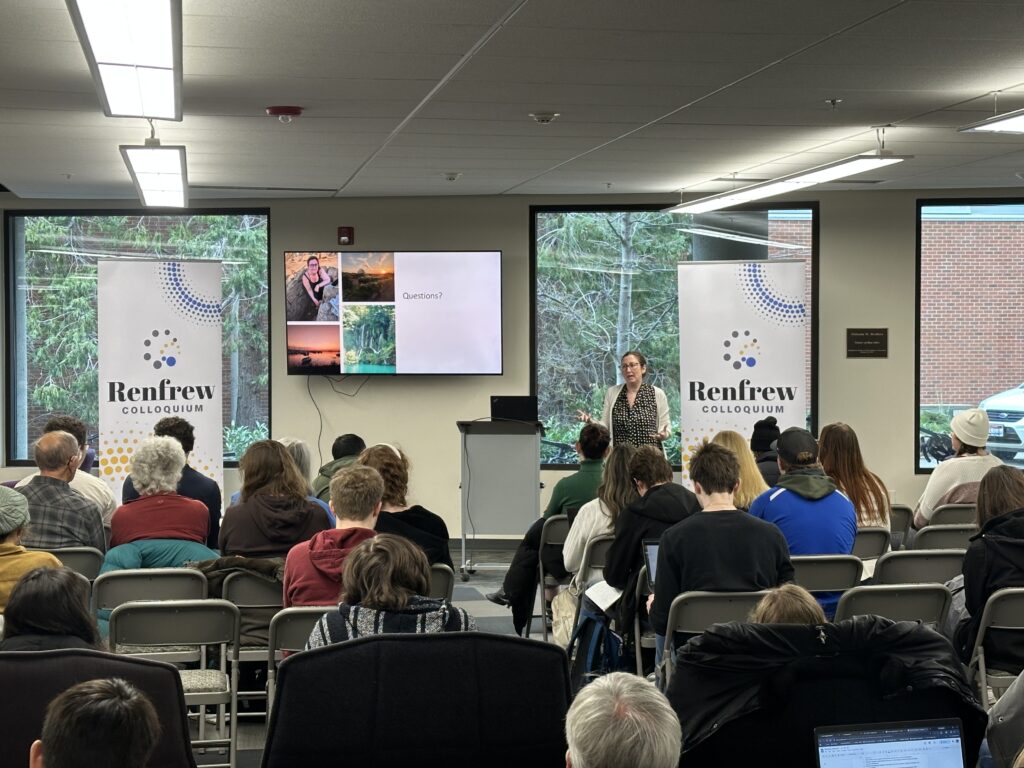
Human remains are rarely just scientific evidence; they carry the power to shape politics, identity, prosecute and hold strong cultural memory long after a person dies. Forensic anthropologist and professor Katharine Kolpan discussed the ethical and cultural dilemmas surrounding human remains at the Renfrew Interdisciplinary Colloquium on Dec. 9.
Kolpan, a forensic anthropologist who has worked in the Balkans, Germany, Vietnam and Southeast Asia, described how bodies become tools, symbols and even weapons in struggles over narratives and power. She emphasized that forensic identification is often technically straightforward, but its public meaning is complicated by ideology, memory and cultural beliefs about the dead. Understanding how the dead are treated can show how societies and cultures remember, reconcile or manipulate history.
During her time in the Balkans, Kolpan said she saw competing narratives, with Croats and Serbs each accusing the other of atrocities. In some mass grave investigations, she was deliberately given false information about the identities and backgrounds of the dead.
“The dead body can’t speak for itself,” she said. “So, people manipulate its purpose.”
Forensic experts generally handle remains from the past 50-75 years, not because they are unable to collect samples older than this, but because, as Kolpan explains, in a medico-legal context, “the person you’d be prosecuting is likely dead.”
Kolpan said that in Thailand, bodies are treated as “eternal teachers,” honored in ceremonies. In contrast, Indigenous groups in Idaho and other parts of North America would sometimes object to photographs of remains being used in research or student projects. Kolpan described one occasion when she had to remove field photos from her university page online after local stakeholders raised concerns. Her collaborators abroad questioned why ancestral remains could be restricted by distant cultural beliefs. The cultural differences present in this field of work can make situations difficult to handle in a way that fairly balances different cultures’ value systems, she said.
Kolpan then described how human remains can spark intense emotional and political reactions. She recalled discovering soldiers’ bodies in “jumbled masses of limbs,” a scene that provoked anger, grief and tension.
She said corpses often become symbols that living groups use to assert identity, territory or historical suffering. This is particularly visible in the Balkans, where remains from World War II, the Communist era and 1990s conflicts are still being found and the meanings debated.
Similarly, officials in areas of Europe also struggled to create a memorial for Nazi soldiers killed in the war which may be located near a memorial dedicated to Jewish victims.
The talk also touched on how forensic anthropology relates to migration, historical memory and the perception of time. Different cultures interpret time differently; what seems distant to one society may feel urgent to another. Kolpan cited greater Serbia as an example, noting that remains can “collapse space and time,” meaning the location of death and recovery carries political and cultural significance over time. Communities often claim ownership over remains as a way of asserting historical presence. Kolpan referred to this with, “Our bodies are here, so this belongs to us.”
Children present some of the most emotionally difficult forensic cases. Identifying them and restoring their identities and remains to the family for a proper burial is important to Kolpan’s work. She quoted an instructor: “If you don’t feel anything, you should step back.” Forensic anthropologists should feel the weight of the work they do and understand the importance of it, Kolpan said.
The work, she explained, is not a “catch the bad guy” or “run around with guns” story, but about restoring identity and names to families as well as providing answers and delivering remains during times of grief.
Despite the scientific focus of forensic anthropology, Kolpan said these stories show how the dead continue to influence the living. Whether through memorials, political claims or unresolved grief, “the past is always present, and it always shapes the future,” Kolpan said.
Sam Welch can be reached at [email protected].