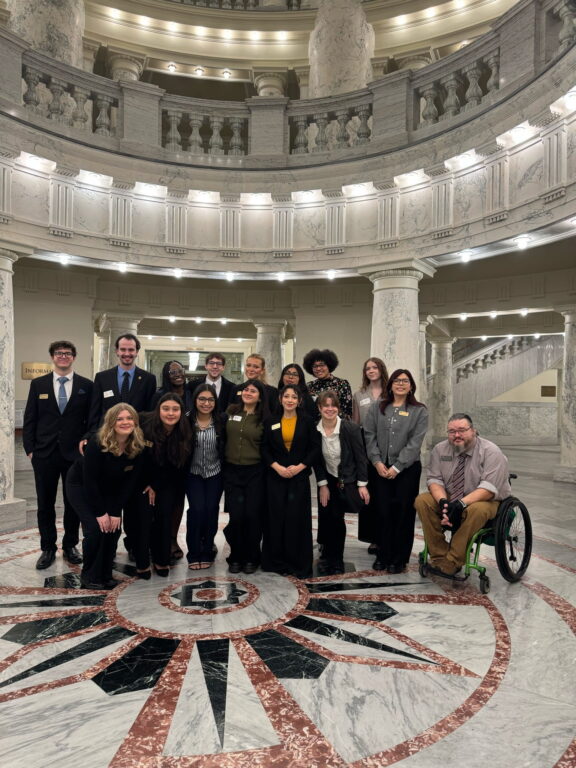
As the Idaho state legislature attempted to balance a $40 million budget deficit, 16 University of Idaho students advocated for higher education programs in the statehouse this week.
The group of students and ASUI members traveled to Boise for the 2026 ASUI Legislative Ambassador trip, an annual opportunity for students to learn about the state’s legislative process firsthand and promote UI interests.
The university-funded trip was planned by Alma Azocar Agurto, ASUI’s director of legislative affairs.
From Jan. 25-27, students stayed at the Hampton Inn and used the James A. McClure Center, a UI public policy research arm, as a home base.
“The beautiful thing about Moscow is that it can be isolated from other places, but when it comes to [the] state government, it can feel very far away. It’s a good opportunity to teach students through experiences,” Agurto said.
The Idaho state legislature is currently running on an estimated deficit of $40.3 million, according to the Idaho Capitol Sun. To balance the budget, some legislators are turning toward cutting fundamental programs such as the Idaho Launch Scholarship, special education funding and Medicaid funding.
“We wanted to focus on Idaho Launch, Idaho Opportunity and the importance of higher education in a place that doesn’t put a lot of attention into it,” Agurto said.
Students sat in on the Senate Education Committee meeting on Monday, Jan. 26, where committee members discussed ways to decrease the deficit while still meeting educator needs. Debbie Critchfield, Idaho’s superintendent of instruction, spoke on a solution to these issues at an open forum during the committee meeting.
Critchfield proposed making Idaho an “Ed-Flex” state, allowing for student support-oriented choices for standardized testing. In Idaho elementary schools, both the state and the federal government require students to take a standardized third grade reading test, which Critchfield pointed out was redundant. Becoming an “Ed-Flex” state would allow Idaho to opt out of the federal test. To implement these changes, the Idaho State Board of Education would need to apply for a waiver.
Afterward, students met with Gov. Brad Little, where he affirmed his commitment to the Idaho Launch program. The program was introduced by Little in 2023 as a grant for Idaho students seeking a two-year, four-year or technical degree after high school if they are entering an in-demand career field.
As Little is nearing the end of his second term as governor, he also talked about his legacy: improved literacy, making the lives of Idaho’s children better, protecting state resources and creating better jobs in the state were milestones achieved in the past eight years that Little highlighted in a Q&A.
In a similar meeting with Lt. Gov. Scott Bedke, ASUI representatives asked questions about the importance of the Launch program and about his addition to the McClure Center Board of Directors. Bedke said that the research being conducted at UI, specifically the McClure Center, would be influential to convincing legislators of the importance of four-year education.
“When we advocate for more funding for [post-secondary] education, we have to show them that their investment leads to quantifiable results,” Bedke said. He also asked student representatives who received the Idaho Launch scholarship to share their stories with legislators.
Idaho Senate Pro Tempore Kelly Anthon echoed Little and Bedke’s recommendation of protecting the Idaho Launch program, but said he wanted to prioritize students wanting to enter a trade or receive a two-year degree.
Anthon also spoke on his vote on House Bill 93, which was signed into law in 2025, granting tax credits for parents to use on private education.
“There are some people who want education to stay the same as it always has been. It must change as people change,” Anthon said.
A coalition of public schools, including the Moscow School District, filed a lawsuit against Idaho’s first private school choice program in September. The next hearing is scheduled for Feb. 11.
Students also met with State Board of Education president Kurt Liebich and vice president William G. Gilbert, who answered questions about the decision to increase in-state tuition by 3.5% in May of 2025. They also spoke about how education pathways need to become more dynamic, broadly applicable and focused on skills-based learning.
Though students were attending the trip to represent the university, there were many opportunities for students to network for their own personal career growth. Students returned to Moscow with the contact information of legislators and leaders in their field of choice and other resources helpful to their future career.
“It’s cool to see how deeply some members of the state government care about students and to see how deep the Vandal social network is,” said Lauren Olsen, a sophomore who participated in the trip.
Josie Adjanohoun can be reached at [email protected].