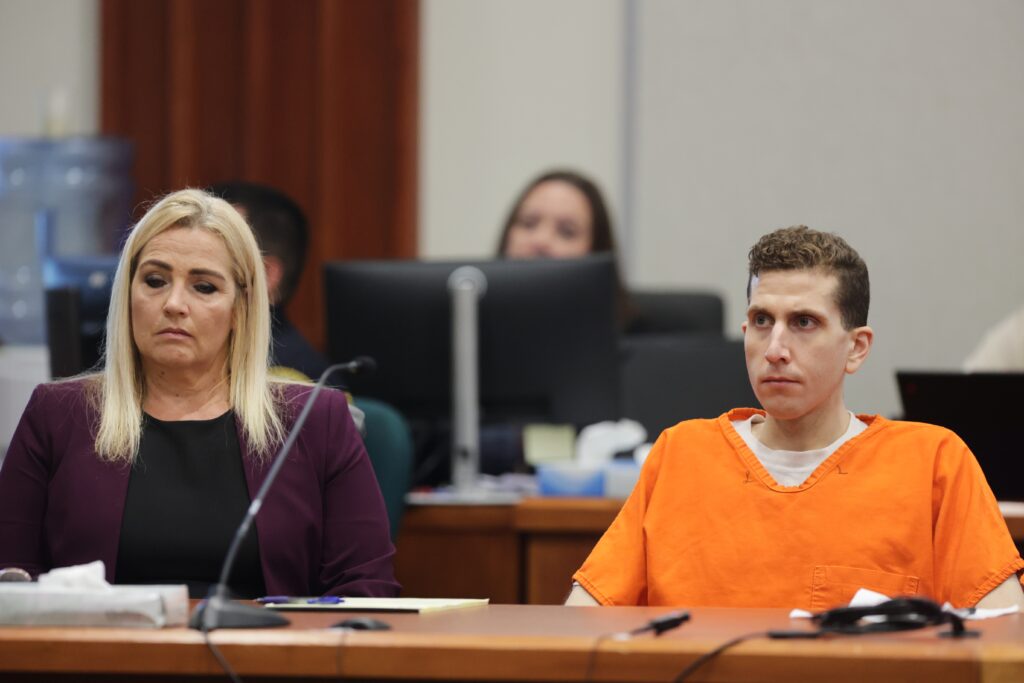
At a digital hearing for State v. Bryan Kohberger on Wednesday, Nov. 5, Fourth Judicial District Judge Steven Hippler took the issue of additional restitution of funeral expenses for the families affected by the quadruple homicide committed by Kohberger under advisement.
The state of Idaho requested additional civil payment from Kohberger on Sept. 22, asking for an additional $20,409.32 for Kristi and Steve Goncalves, the parents of Kaylee Goncalves, and $6,920.32 for Karen Laramie, Madison Mogen’s mother.
Latah County Prosecutor Bill Thompson began the hearing by clarifying the amount requested was now only to be the cost of two urns, at a total of $3,075.58. The plea deal taken by the defendant stipulated Kohberger was responsible for paying restitution for funeral expenses.
The other previously requested money was reimbursement for travel and lodging expenses to attend the sentencing in July, according to Thompson, which he had mistakenly told the families was liable for compensation. As such, these additional restitution expenses requests were rescinded prior to the hearing.
Kohberger was convicted of murdering Madison Mogen, Xana Kernodle, Kaylee Goncalves and Ethan Chapin in November of 2022, pleading guilty to four counts of first-degree murder and one count of felony burglary on July 23, 2025. The plea deal allowed Kohberger to avoid receiving the death penalty, instead being sentenced to four consecutive life terms and over $300,000 in fines and restitution.
Kohberger’s defensive team objected to the state’s request on Oct. 7, arguing against restitution for the travel expenses and stating that the defendant had an inability to pay given his life sentence.
“Current inability to pay is not necessarily a block to the order of restitution. It is just merely a factor for the court to consider,” Thompson said at the hearing. “And it is [the state’s] position given the relative youth of the defendant and the fact that he has been receiving significant moneys during his incarceration already, that there is a possibility of future moneys.”

Thompson said that the state treasurer can impound proceeds from media and publishing deals paid to his account, or that Kohberger could come into inheritance from his family or others.
Defense attorney Elisa Massoth argued that, per the victim’s compensation code, the court must perform an analysis on Kohberger’s ability to pay, which the defense claims he does not have.
Despite Kohberger previously receiving lump sums of money, Massoth said that the situations referenced were prior to the plea deal and that his current situation is drastically different. Many of the lump sums came from Kohberger’s family in relation to the trial, Massoth said.
“There is nothing in the record to provide the court with anything other than what is really speculation based on [the] past, as opposed to some that the court might be able to rely upon,” Massoth said.
Massoth agreed that under the plea deal, restitution for the urns was applicable, as the transportation and lodging costs which fell outside had been withdrawn, but that pursuing it would be unfounded given Kohberger’s inability to pay.
Hippler pressed the defense that Kohberger’s history of receiving lump funds prior to the sentencing was good evidence of what may occur in the future.
“Hasn’t the defendant waved his right to rely on that ability to pay by agreeing to those expenses as part of the plea agreement?” Hippler said. “What is the downside that the victims are as whole as possible from this by ordering the restitution, which again would jump in line [in front of] some of the other court ordered fines?”
The defense had also raised a timeliness objection as the plea agreement specified that funds for restitution were to be determined within 60 days after the sentencing date, which was Sept. 21, 2025, the day before the additional request was submitted.
“It is past [the state’s] 60-day deadline, but I don’t know that that is completely jurisdictional in the way that you drafted your judgement,” Massoth said.
Massoth concluded that among analysis of Kohberger’s ability to pay, the court should take the timeliness factor under review.
The hearing lasted 20 minutes and is available to watch on the Idaho Fourt District Court YouTube page.
Defense attorneys Anne Taylor and Bicka Barlow also attended the hearing but did not make any comments.
Kohberger was not remotely present at the hearing.