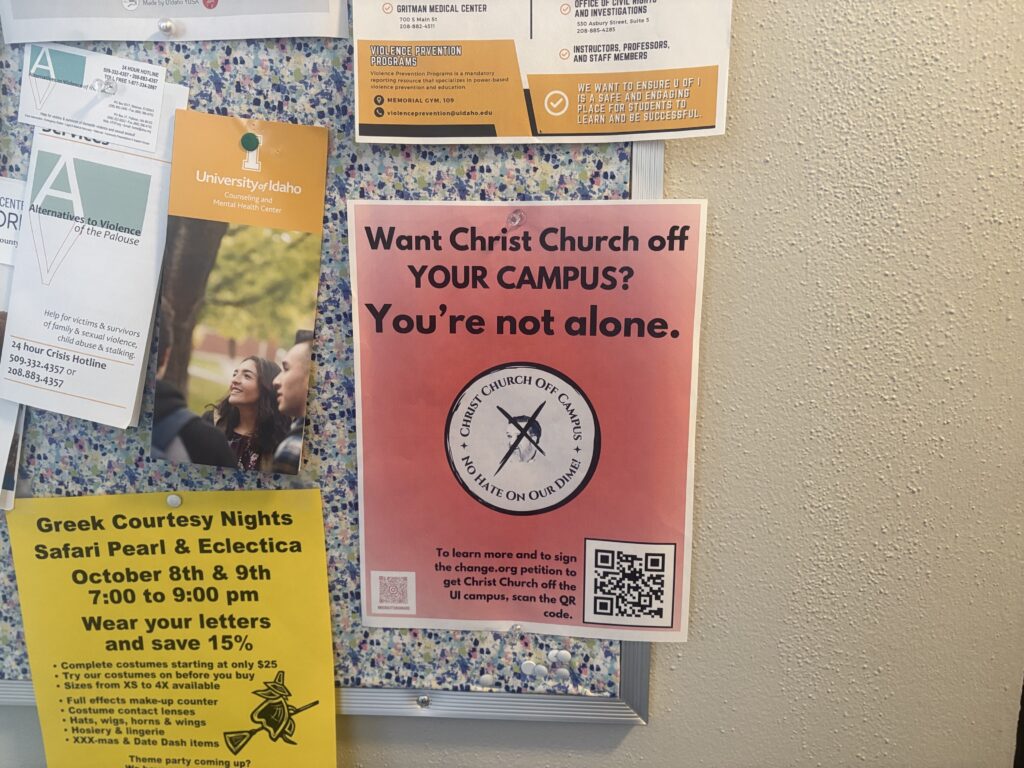
The University of Idaho prides itself on being a place where diverse ideas can be explored freely, but one organization’s involvement on campus continues to stir debate about religion, free speech and inclusion. Christ Church, a conservative Christian congregation based in Moscow, has become a topic of contention for many students due to its active presence on campus through the student group Collegiate Reformed Fellowship.
For some students, CRF’s events and outreach efforts represent a welcoming space for Christian students to strengthen their faith and find community. For others, the group’s association with Christ Church raises concerns about exclusion, political influence and the blending of church and university life.
Matthew Gray, the student leader of CRF, said the group’s primary goal is to support Christian students who often feel isolated or criticized for their beliefs in academic spaces.
“There are many Christian students at UI,” Gray said. “Many of them feel that their faith is regularly attacked or ridiculed in the classroom. Christ Church, through the ministry of Collegiate Reformed Fellowship, seeks to encourage those students to not abandon their faith, but to grow and mature in it. We also encourage open discussion and debate between opposing worldviews. This is healthy for all, and I believe it adds the atmosphere of respect and freedom of thought, which should prevail in a university setting.”
CRF regularly hosts lectures and discussions through its “Colliding Worldviews” series, where students and speakers engage in debates over science, philosophy and faith. Gray said these events are designed to promote dialogue, not division.
“Several times a year, CRF sponsors or puts on an event in our ‘Colliding Worldviews’ Lecture Series,” Gray said. “Unfortunately, the one planned earlier this semester was canceled due to security concerns after the murder of Charlie Kirk. Students who value free speech and fair and open debate appreciate what we do and are glad to see us do it, even if they do not share our convictions.”
Still, CRF’s connection to Christ Church, a congregation that has faced controversy over its social and political stances, has made some students uneasy. Many on campus feel that the church’s conservative theology conflicts with the inclusive and pluralistic values the university promotes.

“I don’t mind religious groups being on campus,” said one UI junior, who asked not to be named. “But Christ Church has a reputation in town for being politically charged and outspoken about certain issues. It makes some of us feel like the university is giving them space to push those views on students.”
When asked about these concerns, Gray said the group’s mission isn’t political — it’s about challenging assumptions and creating opportunities for honest discussion. He also elaborated on why some students of faith feel tension in the classroom.
“The prevailing worldview at UI is secular and built upon evolutionary assumptions,” Gray said. “The Christian faith asserts that there is a Creator and a distinction between the Creator and the creation. The theory of evolution is just that — a theory. It’s a faith position, just as Christianity is. Secularism wants to deny that, but the reality is that education is not neutral. All education is theological at some level. This is why we’ve titled our lecture series ‘Colliding Worldviews.’”
Whether one agrees with Gray or not, his comments highlight the deeper question at the heart of the debate: What role should religion play in public education?
Christ Church’s campus involvement may make some students uncomfortable, but it also raises important conversations about the boundaries of free speech, faith and intellectual diversity. In a university setting where differing ideas are meant to be tested, debated and defended, that tension, however uncomfortable, might be exactly what higher education is supposed to provoke.
AJ Pearman can be reached at [email protected].