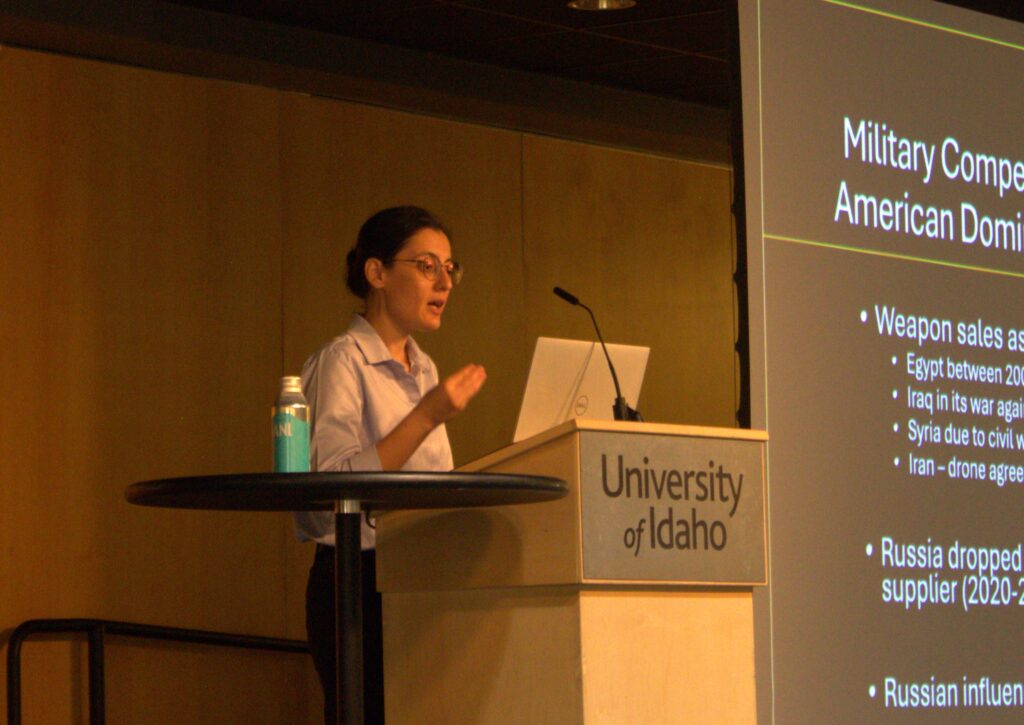
A period of significant U.S. global economic and political power is ending, visiting scholar Emine Arı said at the Borah Symposium Renfrew Colloquium talk on Sept. 30.
Arı, a visiting scholar of international relations, discussed “Great Power Competition in the 21st Century: A View from the Middle East” as a part of the 2025 Borah Symposium.
Since the end of the Cold War, there has been a brief period of U.S. unipolar dominance in which the U.S. has held significant economic and political power globally, but that period is ending, Arı said. Russia and China, the rising world powers, are exploiting U.S. policy mistakes to move toward a multipolar world order. The battleground for this new world order is the Middle East.
In international relations, scholars measure power in a variety of ways, including economy, military, population and soft powers like cultural influence, language, media, education and political influence.
Great powers have substantial hard and soft power capabilities across multiple dimensions, Arı explained, and states with moderate capabilities are middle powers. These middle powers can usually exert some sort of regional influence and often leverage relations with greater powers.
“With the fall of the Soviet Union, we have a brief period of unchallenged American hegemony until around 2006, Iraq and Afghanistan fail, and 2008, financial crisis,” Arı said.
“Right now, finally, including today’s world, there is a systemic uncertainty. The IR scholars do not even agree on what kind of structure we are living in,” Arı said. Scholars disagree on whether the current state of the world is still unipolar, bipolar with the U.S. and China or multipolar.

But even as they disagree on the classification, scholars can agree that systemic transitions and uncertainty increase the likelihood of international conflict.
In the Middle East, Arı said the narrative of the last 10 years has focused on retreating U.S. influence, rising Chinese economic influence and a disruptive Russian role.
But, Arı said, that is an oversimplification.
“While adapting its approach, the U.S. continues to rely on heavily military and security partnerships in the region. China, on the other hand, emphasizes economic connectivity,” she said. Russia has involved itself in the weapons and energy sectors in the region to strengthen its presence.
“In reality, each power has its own strengths and strategies.”
In the economic domain, the main source of competition in the Middle East is between the U.S. and China. In 2024, China imported 24.6% of the world’s crude oil, giving it strong influence over the Gulf’s oil market.
The U.S., acknowledging this competition, has created many new commercial agreements with Saudi Arabia and the United Arab Emirates, and is also offering other infrastructure initiatives.
As for Russia, its economic influence mostly consists of energy cooperation with gas pipelines and nuclear fuel.
In the military domain, the U.S. and Russia are the main competitors.
Russia has increased weapons sales in the Middle East to create a wedge between the U.S. and countries that buy U.S. arms. “Russia has been offering weapons for the states that U.S. is refusing to provide,” Arı said.
However, this changed after the beginning of the Russia-Ukraine War, when Russian arms market share in the region declined.
China’s military engagement in the region has increased with the gap left by Russia, with arms exports to the Middle East rapidly growing. “It offers weapons for all states, for all types of states, authoritarian or democratic, it doesn’t matter, without any restrictions. And also, it’s cheaper than the Western alternatives,” Arı said.
Despite all these changes in the military economy, Arı claimed that American military influence in the region is still unchallenged. “Starting from the Obama Administration, the U.S. has pivoted from security guarantor to multilateral security integrator in the region,” she said, “highlighting the security partnership rather than direct intervention.”
The U.S. also maintains defense agreements in the area, with Israel, Egypt, Jordan, Iraq and Lebanon among those receiving military aid.
The final domain, diplomatic and political interactions, is still dominated by the U.S., Arı argued.
While all three powers have some level of diplomatic tie to the various states in the region, China and Russia rely on states that face a large number of problems.
“Even though these diplomatic activities take a lot of attention in the media, the historical rivalry and distrust between Saudi Arabia and Iran has not resolved, Assad’s regime has fallen or the Palestine is not really unified,” Arı said.
Regional powers make use of the competition between the three great powers to gain power of their own. The states maintain relations with multiple great powers at the same time to avoid over-dependence on any single partner while maximizing opportunities for security and economic growth.
Saudi Arabia, for example, balances U.S. defense systems, Russian energy production and Chinese Belt and Road Initiative infrastructure. Iran, on the other hand, uses its ties with China to sell oil and Russia to provide drone technology, despite U.S. pressure.
Arı will join the Department of Politics and Philosophy at the University of Idaho as an adjunct instructor in Spring 2026.
The Borah Symposium is an annual event at UI that aims to educate on and improve global peace and relations. Featuring lectures, panel discussions and community events, the symposium brings together international leaders, activists and scholars to discuss solutions to war and conflict.
The symposium is sponsored by the Borah Foundation, named in honor of Sen. William E. Borah, a leader in international cooperation and diplomacy.
The 2025 symposium centered on “Great Power Competition.” It marked the 87th year and the 78th consecutive year of the program.
Dakota Steffen can be reached at [email protected].