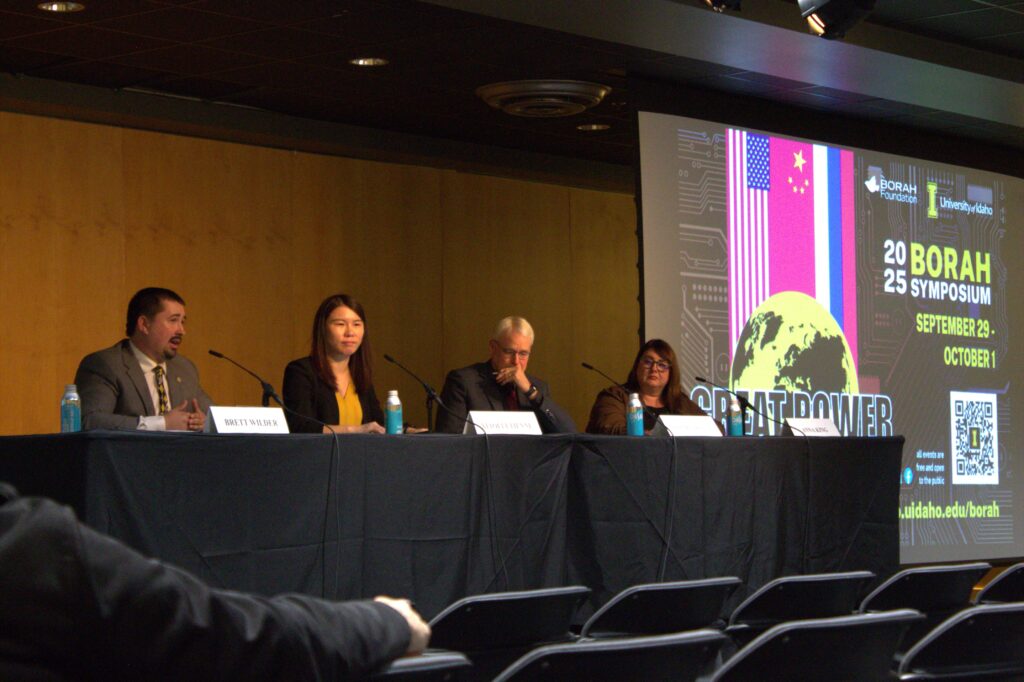
Tariffs are hitting American farmers and producers hard, speakers said at the Sept. 29 panel of the 2025 Borah Symposium.
The first talk of the 2025 Borah Symposium kicked off on Monday evening with a panel discussion, “The Impacts of Trade Wars on Agricultural Commodities.” The panel featured University of Idaho agricultural economics professors and local farmers.
Tariffs are a major source of rising production costs for farmers, the panelists said. Xiaoli Etienne, a UI professor of agricultural economics, mentioned machinery, which has been subject to high tariffs on steel. Etienne is the Idaho Wheat Commission Endowed Chair in Commodity Risk Management at UI and focuses on agricultural policy and business.
“We could lower the cost of production by just getting along with each other around the world,” Tim McGreevy, CEO of USA Pulses and a local farmer, suggested. “Getting along with each other, that would lower the cost of production because the cost of goods and input would flow in their natural form to where they’re at their lowest cost.”
USA Pulses is an organization promoting research and consumption of U.S. pulse crops. Pulse crops include lentils, beans and chickpeas.
Tariffs are not a new concept in U.S. trade. However, the recent tariffs have some differences, according to Brett Wilder, an assistant professor of agricultural finance and business management.
“Doing it in such a broad-based format is a little different. It certainly has caused some damage for some of our large commodities, and especially commodities that rely on export trade,” Wilder said.

Along with his position as a UI Extension educator, Wilder co-owns Boise River Lamb, a family ranch based in Caldwell, with his wife, Liz Wilder. The two are second-generation sheep producers.
Tariffs and increasing trade deficits could also weaken the U.S.’ position in the global market, Etienne said.
“There’s a saying that a lost buyer today means a lost market for decades, because it’s really hard to build those trade relationships,” Etienne said. “The U.S. has gained a reputation of being a very reliable supplier in the global market, and I think losing the market because of trade war is very detrimental and it would be very hard to regain this market back.”
The agriculture industry is also feeling the effects of cuts to research programs nationwide, including USDA programs in Idaho. The panelists discussed the importance of these programs, sharing examples of the impacts they have.
Despite farm acreage declining over the years, U.S. agricultural production numbers have been continuing to grow. “If you ask the question, why are we seeing higher productivity? The answer is research and innovation,” Etienne said. “If we cut the research centers, I think that’s going to have a very detrimental effect on U.S. agriculture.”
McGreevy said that USA Pulses relies heavily on the USDA Agricultural Research Service program at Washington State University, which houses a breeding program for wheat and lentils as well as a seed bank.
“These are long-term investments in agriculture that have proven year after year, decade after decade, has put U.S. agriculture in the no. 1 position in terms of productivity around the world, and when we erode our research efforts, it’s very frightening because it’s hard to get it back and hard to lose that kind of momentum,” McGreevy said. “We have a lot of international students that help staff these research programs as well, and that has been challenging, to say the least, for the universities.”
Research could potentially be impacted by stricter immigration policies as well.
“Something that we have been talking a lot about just this week since I’ve been on campus is, will the $100,000 need for an H-1B visa impact our ability to have academics at our research stations? Because there are, I didn’t realize this until today, quite a few folks in the academic roles that rely on that visa,” Wilder said.
General farm labor will also be impacted, Wilder said, particularly in the livestock and tree fruit and vegetable sectors. In Fiscal Year 2021-2022, approximately 42% of crop workers were unauthorized to work in the U.S.
However, Wilder believes that is not the case in Idaho. “I think regionally in Idaho, we really haven’t seen the shortages that we expected. You know, people like to talk and say that there’s a lot of illegal labor in the dairy system. They really haven’t heard shortages in that system,” he said.
One major barrier farmers have seen is large declines in crop sale prices since Jan. 1. While pulses have been fairly profitable for the past two years, wheat, barley and canola have not, McGreevy said, meaning those demographics of farmers are having a difficult time coping with low commodity prices.
Midwestern soybean producers are suffering significantly due to current trade deficits, Etienne said.
China accounted for about 60% of total soybean imports as of February 2024, with 51% of the U.S.’ soybean production heading to China. However, China’s imports of soybeans from the U.S. were down 43.7% in April 2025 from April 2024.
Overall, each of the three panelists had positive outlooks on the future of U.S. agriculture.
“I’m very optimistic about U.S. agriculture moving forward,” McGreevy said. “We are in a short-term pain situation with these tariffs. We will make it through.”
“We have a very diverse crop base in all of these states in the…Pacific Northwest region. Ag and ag production is very important to those states’ individual lives,” Wilder said. “[There is] a lot of support from those states to keep trade moving.”
“History has [told] us over and again and again that farmers are very resilient,” Etienne said. “I think this time American agriculture is going to continue to adapt and continue to thrive.”
The Borah Symposium is an annual event at UI that aims to educate on and improve global peace and relations. Featuring lectures, panel discussions and community events, the symposium brings together international leaders, activists and scholars to discuss solutions to war and conflict.
The symposium is sponsored by the Borah Foundation, named in honor of Sen. William E. Borah, a leader in international cooperation and diplomacy.
The 2025 symposium centers on “Great Power Competition.” It marks the 87th year and the 78th consecutive year of the program.
Monday’s panel was moderated by Anna King, a senior correspondent for Northwest Public Broadcasting.
Dakota Steffen can be reached at [email protected].