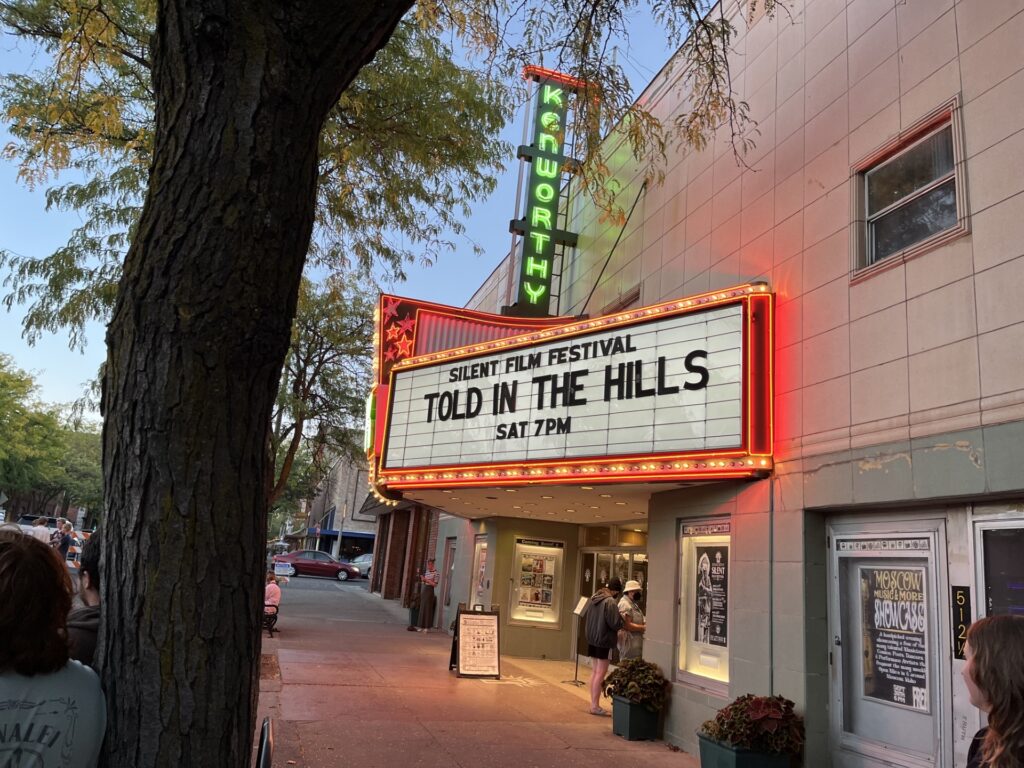
“Told in the Hills,” the first feature film shot in Idaho, was released in 1919. While the Western film was successful, no copies remained in the U.S. after the 1980s. When Boise State University professor and film historian Tom Trusky learned there was a copy in the Soviet Film Archive, he wrote and asked for a copy.
Despite the two countries being in the middle of the Cold War, the Soviets sent him the original nitrate film in two reels. He screened the surviving footage in 1990, but Trusky admits that audiences were given “cinema interruptus” due to the choppy and incomplete nature of the film. The first and last 15 minutes of the film are missing. Since then, the reels have been moldering in the BSU Albertsons Library’s Special Collections.
The Kenworthy Performing Arts Center screened the newly rediscovered and restored “Told in the Hills” on Sept. 26 and 27 as a part of their annual Silent Film Festival.
BSU archivists Gwyn Hervochon and Alessandro Meregaglia, Nez Perce Director of Cultural Resources Nakia Williamson-Cloud and film editor Tom Frank collaborated to restore what was left of the film and synthesize surviving promotional photographs into a continuous, congruent feature.
Navajo pianist Connor Chee composed an all-new soundtrack to accompany the film that was performed live by a Washington State University string quintet.
The film is about “Genesee” Jack Stuart, a white miner who, in 1870, moves west to escape family shame. In the west, he falls for a frontier woman and develops close ties with Kootenai leaders, played by Nez Perce actors. Therein lies one reason why the film is so unique. While in most westerns, Native people were portrayed by white actors in manufactured stereotypical Amerindian regalia, in this film, “either out of laziness or lack of resources, they weren’t costumed like modern films or the Spaghetti Westerns we used to see,” said Williamson-Cloud. In this film, the Nez Perce costumed themselves and gave true renditions of their culture.
Frank called this a “rare, unique and significant case of representation.” Tribal leaders met and decided to engage in the film. Williamson-Cloud described some cultural specifics shown in the film. Nez Perce buckskin clothing shows reverence to deer, who, in Nez Perce belief, advocated for humans in the beginning of time.

After battle, Nez Perce soldiers would ride three circles around camp on horseback. Colin Mannex, the executive director of the KPAC, hoped the screening would “credit the unacknowledged actors from over 100 years ago.”
Hervochon also hopes to acknowledge the “people, work and cultures involved.” Frank wants this screening to be just the first iteration of “Told in the Hills” and, as more stories come to light, he hopes he can compile a more comprehensive product.
Meregaglia wants this screening to catalyze the development of other films and promote the history of film in Idaho. Williamson-Cloud, in another manner, hopes the film communicates the resilience of the Nez Perce and their “enduring relationship with this land.”
The Silent Film Festival this year celebrated early Idaho filmmakers and offered an intriguing slice into Idaho history.
Miriam Moore can be reached at [email protected]