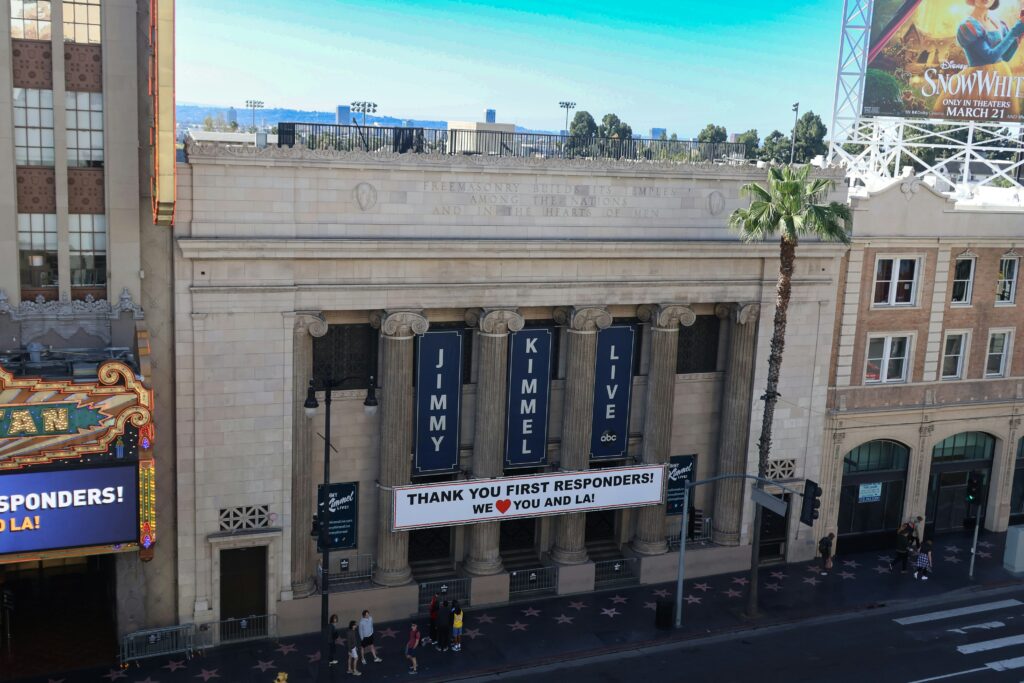
On Monday morning, “Jimmy Kimmel Live!” was reinstated and set to return on the evening of Tuesday, Sept. 23. This ends the show’s week-long suspension after controversial remarks Kimmel had made about the recent assassination of Charlie Kirk.
This came days after societal pressure on Disney from unions, advocacy groups and viewers as well as boycott threats that quickly spread through social media. According to an article by The New York Times, ABC executives had “thoughtful conversations” with Kimmel before reinstating him.
Last week, ABC, which is owned by the Disney Corporation, suspended the show indefinitely after comments Kimmel had made in his opening monologue.
“We hit some new lows over the weekend with the MAGA gang desperately trying to characterize this kid who murdered Charlie Kirk as anything other than one of them and doing everything they can to score political points from it,” Kimmel had said.
The remark sparked backlash among conservatives, who said that the statement was extremely insensitive to the matter.
Brendan Carr, the chairman of the Federal Communications Commission, threatened legal consequences for ABC if the network failed to act.
Disney finally released a statement on the matter after days of silence.

“Last Wednesday, we made the decision to suspend production on the show to avoid further inflaming a tense situation at an emotional moment for our country,” the Walt Disney Company, which owns ABC, said in a statement in The New York Times. “It is a decision we made because we felt some of the comments were ill-timed and thus insensitive.”
The suspension created a whirlwind of civil unrest among supporters of Kimmel. Civil liberty groups, including the American Civil Liberties Union, and more than 400 entertainers signed a letter condemning Disney, calling it an act against freedom of speech.
Calls to boycott the company and any others owned by Disney spread quickly through social media.
The decision to bring Kimmel back highlights the competing forces facing Disney: threats and affiliate pushback on one side and public pressure and reputational standing on the other. NBC News reported that the company’s stock dipped as the suspension drew criticism.
The Argonaut previously reported on the suspension and concerns over freedom of speech.
Kimmel did not make any official remarks on his suspension or on his reinstatement in the week that followed. According to The New York Times, he has not responded to any questions regarding a comment.
Kimmel was going to address the issue during Wednesday’s, Sept. 17, episode, but after reviewing his remarks, the network had decided to “bench” him, according to The New York Times.
During the airing of the show, Kimmel finally addressed the situation in a tear-filled monologue that was met by several standing ovations from the audience.
Kimmel said that he understood why his remarks were received as insensitive and ill-timed.
“It was never my intention to make light of the murder of a young man,” he said.
While Kimmel had sympathy for his supporters and even people who did not support him, he still harshly criticized the Trump administration, saying that silencing “a comedian the president doesn’t like is anti-American.”
President Donald Trump, who has spent the past week celebrating the suspension and praising it as “great news for America” on his Truth Social social media platform, has also not commented on ABC’s latest decision.
The silence leaves many unanswered questions. Why did Kimmel wait for his return to address the controversy directly? Will Trump now target ABC and Disney for bringing him back, as he has done with other late night shows in the past?
The larger issue is not just whether Kimmel’s remarks were poorly timed. It is about what his suspension and reinstatement mean for the boundaries of political speech in entertainment. Disney’s decision to first cave to political pressure and then reverse it only a week later only reinforces how fragile those boundaries have become.
What happened with Kimmel shows how quickly networks can be swayed by the loudest political voices, and just as quickly be pulled back by public outrage. It is a reminder that speech on late night television is no longer judged only by audiences at home, but by the boardrooms of corporations that own it. If every controversial joke or monologue becomes a stake in a network’s survival, then the future of political comedy may be dedicated less by creativity and more by fear.
“The show is not important,” Kimmel said. “What’s important is that we get to live in a country that allows us to have a show like this.”
Andrea Roberts can be reached at [email protected].