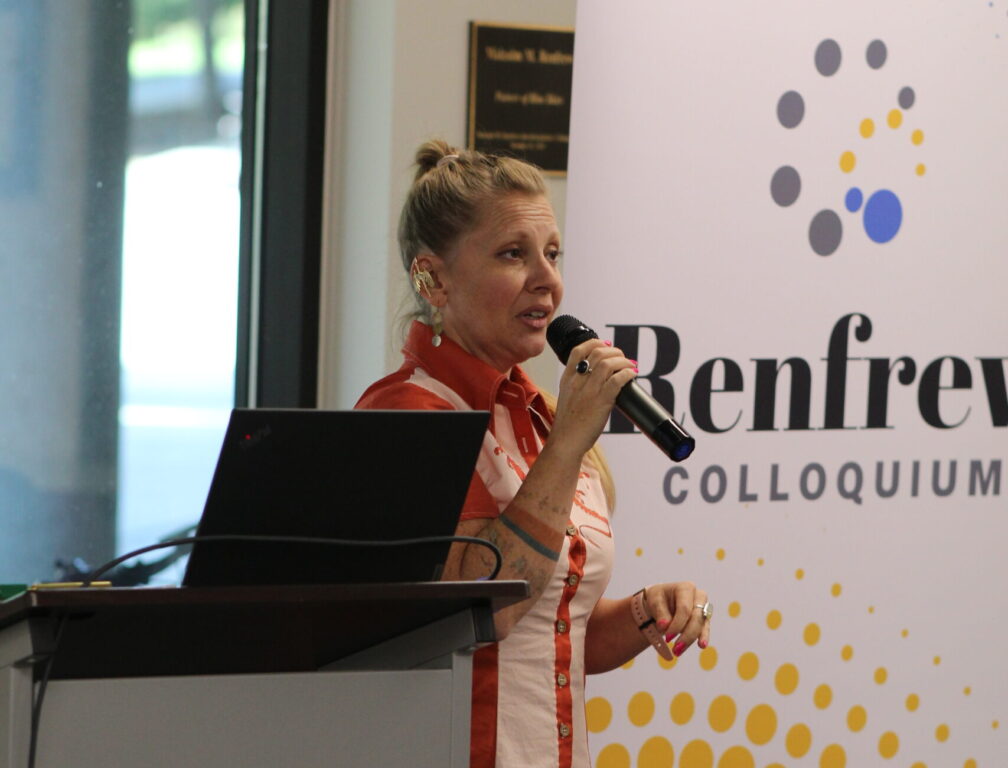
University of Idaho professor Rebecca Scofield discussed the intersection of feminism and fiction in her presentation of “Burn It All Down: The Feminist Imagination in 20th Century Dragon Riding Fiction,” on Sept. 16.
Scofield is an associate professor of American history and chair of the History Department at UI. This talk was a part of her current research, titled “Astride the Beast: Women Riding Horses, Dragons, and Everything In-Between.” She has previously authored “Outriders: Rodeo at the Fringes of the American West” and co-authored “Slapping Leather: Queer Cowfolx at the Gay Rodeo.”
In the 19th century, women rarely rode astride on horses as it was seen as damaging to the reproductive system, Scofield began to explain. What changed it, she argued, is the bicycle.
In its early days, the bicycle was difficult to ride, even without a skirt. Then came the safety bike, which featured a drop in the center that allowed those with skirts to ride it and also featured softer wheels.
“We have, for instance, a case in Central Park in New York where a very famous actress is writing astride her horse. She gets arrested for disturbing the peace. And it goes all the way up to Theodore Roosevelt, who was, at the time, the head of the police commissioners in New York,” Scofield said. “And he comes down and says, well, it’s not technically illegal for women to ride astride, and we let them do it with bicycles, so we kind of have to let them start doing it with horses as well.”
The bicycle then became a political symbol for the early feminist movement. As women riding astride horses became more normal, the fiction of the 20th century began to branch out to other species. As Scofield put it, “It’s always female characters that are pushing society forward in these books.”
Anne McCaffrey, the author of “Dragonriders of Pern,” entered the male-dominated science fiction genre with criticisms of its use of women as props for male heroes.

The first book of the series was originally published in 1967 as two separate novellas in science fiction magazine “Analog.” McCaffrey combined the two for publication in 1968.
The society of Pern centers around Dragonriders or Weyrfolk, who are telepathically linked with their own dragon and live in communities called Weyrs.
“[There’s] this notion that sex and power are inherently linked … [but] we don’t really know if bodily autonomy will be protected at all costs, or whether that is simply the price you have to pay to gain political power,” Scofield said.
Scofield is also interested in the way “Game of Thrones” character Daenerys Targaryen interacts with power and her own dragons.
“Through her access to weapons of mass destruction who are themselves living, breathing things that acknowledge her as a mother and have this sort of different loyalty to her, she can reshape the world,” Scofield said.
But even Daenerys’ authority is still grounded in some other tool. “Daenerys is very insistent that she is the dragon, that she is the prince that was promised and rules through her own authority, but she still needs her dragons to make it happen,” Scofield said.
Scofield concluded that both personal and political authority for women still requires some sort of tool or external support. Power also tends to tie back into reproduction and bodily autonomy. “You can be the Mother of Dragons, but you still have to be a mom,” she said.
The next Renfrew Colloquium presentation will be hosted by Markie McBrayer, a professor of political science. McBrayer will explore the history of voting rights and citizenship in “Voices and Votes: Democracy in America” on Tuesday, Sept. 23.
The Malcolm Renfrew Interdisciplinary Colloquium began in 2001 and is sponsored by the College of Letters, Arts and Social Sciences and the UI Library. Presentations are hosted weekly on Tuesdays from 12:30-1:30 p.m. on the first floor of the library.
For more information on the Renfrew Colloquium and the semester schedule, visit www.uidaho.edu/letters-arts-social-sciences/news-events/renfrew-colloquium.
Dakota Steffen can be reached at [email protected].