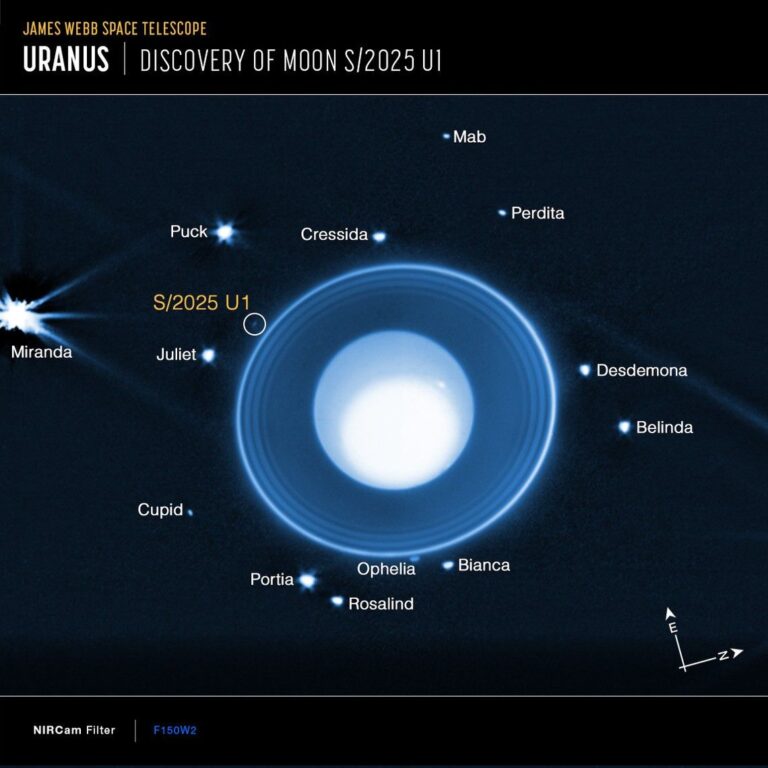
University of Idaho’s Matthew Hedman, a professor of physics, and a team of researchers from other institutions, led by the Southwest Research Institute, discovered a 14th moon orbiting Uranus in February of this year. This has raised the total number of moons for this planet to 29. The new moon has been temporarily named S/2025 U1.
The research team collected 10 40-minute long-exposure images of Uranus from NASA’s James Webb Space Telescope and spent the following six months isolating signals from the images to identify small moons.
“We found all of the moons that were known, and then we started to look for things that might not be known and might be new,” said Hedman.
According to Hedman, his team is still in the first steps of understanding the moon.
“There are implications of [the discovery], but how it fits into the broader Uranus system is still something that people are looking into,” Hedman said.
His team will continue to investigate measurements of the moon’s size and orbit so that future research teams can take more precise measurements of the satellite.
The moons around Uranus are relatively small objects, but according to Hedman, their orbits are so close to each other that they could crash into each other within the next four to 10 million years. Hedman is interested in understanding if the addition of a new moon to Uranus’ orbit will change our understanding of the stability of the system. There have never been any observed collisions in simulations of Uranus’ moons.

Hedman’s team seeks to involve UI students in the ongoing research into Uranus’ new moon.
“Student researchers have played an important role in kind of the broader project which has allowed this to happen,” Hedman said. “Students have been working on a variety of projects to study the Uranian rings and moons … and they are part of the reason why UI is doing more on the Uranian rings than any other institution at this time.”
Miles Butler can be reached at [email protected].