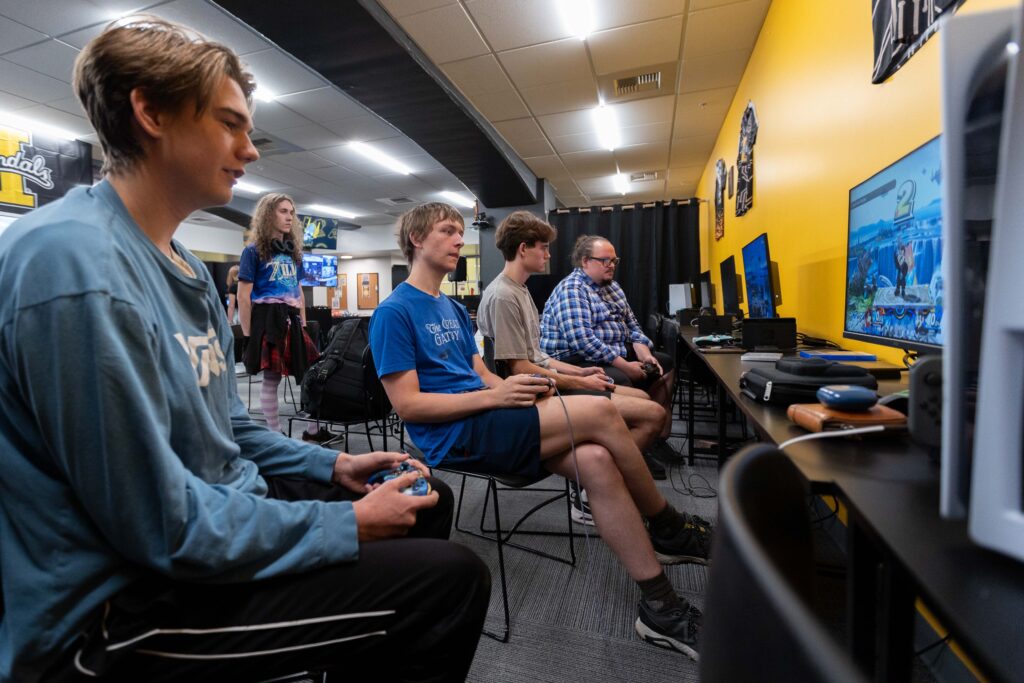
As the University of Idaho Esports program enters its third year, it has instituted a new pay-to-play fee structure to help fund the program.
This year, Esports instituted a $50 membership fee per semester for all players, but higher-ranked players can get the fee waived. Esports also added options for non-members to use the gaming facilities in the Bruce Pitman Center basement, which includes $5 day passes, $50 per semester and $75 for an academic year.
The fees should generate about $10,000 in annual income, according to Esports director Wayne Ebenroth.
Ebenroth told The Argonaut the fees help the team’s budget and instill a sense of commitment to the competitions.
“It’s a matter of showing the commitment that our players have, as well as helping to fill the needs of the team, including jerseys and travel and equipment,” Ebenroth said. “We are always striving to be welcoming to all players, but these fees also help increase the quality of the Esports program.”
Esports has grown from 24 players in fall of 2023 to 110 this semester. The program has won back-to-back Big Sky championships in multiple titles. It was also a national runner-up in Counter-Strike 2. The program had 10,000 visitors to its gaming lab last year, Ebenroth added.
In April, Esports approached the Student Fee Committee, comprised of members of ASUI and the Graduate and Professional Student Association, to institute a $2 student fee dedicated to Esports. The committee denied the request. If ASUI had funded the fee request, there would have been no need to charge a player fee, Ebenroth said. The proposed fee would have raised about $30,000. Esports’ annual budget is about $180,000, allocated by Student Affairs.

Other student programs on campus charge fees for participation, such as intramural and club sports and Student Recreation Center programs.
Two Esports players told The Argonaut that they understand the need for a fee, but questioned the amount.
Thomas Hubbell, a member of the varsity Rainbow Six Siege team, said that $50 seems “steep.”
“I can understand and see why a player fee is an option, but the amount is concerning to me,” Hubbell said. “I know that if I was a freshman and I was shown these fees, I likely wouldn’t have joined.”
Hubbell also discussed the importance of funding for esports organizations. “Travel is expensive, equipment is expensive. A fee is a realistic option, but $50 is really steep, and I think that excluding some players based on rank is not a good way to waive something like a fee.”
Zachary Callos, a member of the Varsity Rocket League team, shared his concern for team morale. “This fee is an easy method for the Esports team to get better funding, but it is creating tension, so why not just have everyone pay or no one pay?” Callos said.
These payments are also creating some discouragement among some members, according to Callos, because many of these video games are able to be downloaded and played for free. “I have a friend in another team. The fact that he now has to pay to play a game that he could play for free at home is incredibly upsetting to him,” Callos said.
The Esports program has also increased the production quality of its streams through Twitch and YouTube. They have a new broadcasting room and increased quality of equipment. There’s also a new viewing area to see other matches and review past games and tournaments.
This semester also marks the start of an academic support program. “We want to implement our version of what the athletic programs do to help support and lift up our players,” Ebenroth said,
All current members with a GPA of 2.5 or less must check in with a liaison once a week, who will monitor their grades and progress to ensure that they are academically successful.
“We are taking this seriously. If someone’s behind, they’re getting benched,” Ebenroth said. “We want our players to succeed, but that means they must also be fully successful with their classes.”
Austin Kieckhefer can be reached at [email protected].