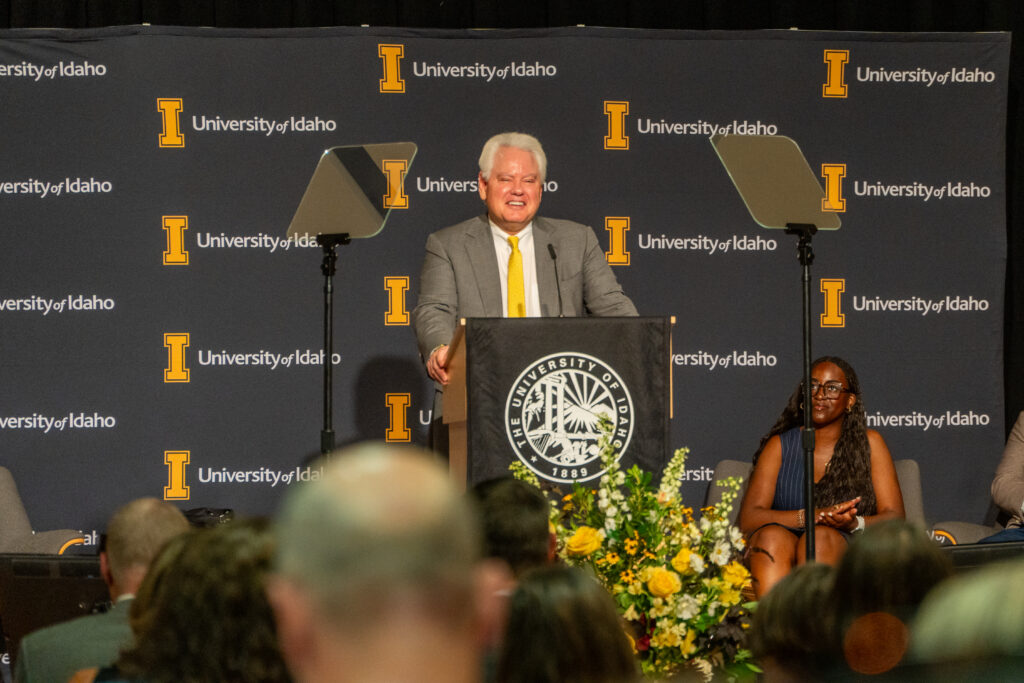
The University of Idaho is expecting a record number of students this fall despite some challenges, UI President Scott Green said at the State of the University Address on Sept. 2.
Green addressed the UI community Tuesday morning, discussing university achievements, budget updates and the status of various projects. He also introduced the university’s four-year strategic plan. Concerns at the forefront of attendees’ minds included international student security, budget cuts, staff support, new technologies and upcoming projects.
Although enrollment is likely to be up again this fall, Green said the number of incoming international students this year will be down by over 50%.
“It’s not the best time to be an international student,” international graduate student Mohammad Abbaspour shared.

“I know how difficult it’s been. The environment the uncertainty has created has been bad for us as a university … [but] we’re glad you’re here,” Green replied.
Sarah Castle, an assistant professor of mathematics education, asked how the university was planning to better support staff and faculty, especially if budget cuts continue. Castle offered low staff pay as a potential area for improvement.
“It’s not just the staff, we’re all underpaid, you know. And as part of you know, living here, we choose to live here, and we could go eight miles away and probably get paid a lot more,” Green said. According to UI’s Faculty and Exempt Salaries Operating Budgets report for Fiscal Year 2023-2024, Green’s salary for fiscal year as $465,234.74.
“If you want to make top dollar, you need to go work for a private institution,” Green said in response to another question about staff recognition and retention.
UI also announced the Strategic Plan Investment Grant Program, a one-time internal funding opportunity for ideas that support the university’s goals. All UI employees are eligible to apply for grants of $5,000 or more, with multi-year proposals considered as well.
Projects will be evaluated on return on investment to the university, collaboration across departments and integration of artificial intelligence.
The proposal deadline is Oct. 1, with awards announced Nov. 1 and funding dispersed beginning Jan. 1. Proposals should be submitted online at www.uidaho.edu/about/thinking-big/strategic-plan.
Regarding government funding, Idaho Governor Brad Little’s recent budget cut of $5 million from UI’s general funds is likely to be permanent, according to Green.
Green also highlighted UI’s recent records with the “Brave. Bold. Unstoppable.” fundraising campaign. The April 1-2, 2025, Vandal Giving Day pushed the “Brave. Bold. Unstoppable.” philanthropic campaign past its original $500 million goal, making it the largest nonprofit fundraising campaign in Idaho history. The campaign will officially end on Dec. 31, 2025.
Green discussed several recently completed and upcoming projects, including the Center for Agriculture, Food and the Environment in the Magic Valley, which will be the largest research dairy in the nation. Also in the agricultural sector, the new Meat Science and Innovation Center in Moscow will be up and running this fall, according to Green.
“Despite the enrollment cliff beginning this year, we’re fortifying our base and investing in our residential infrastructure,” Green said. Undergraduate housing remodeling is underway, with renovations completed on the top three floors of Theophilus Tower and continuing in the Wallace Residence Center. The new South Hill residences are expected to be completed by next fall.
“This summer alone, we put more money into campus projects at any time in modern history,” Green said. “We like to joke if there’s a road that hasn’t been torn up, let us know. We’ll make sure we get it.”
In February, UI achieved Carnegie R1 research status and was the first institution in Idaho to do so. Research expenditures reached $140 million in 2024.
“As we deliver on our land grant mission of access for students and research for our state, we provide $2.5 billion in economic impact to Idaho each and every year,” Green said. “We’re planting our flag as Idaho’s research university.”
Green, along with Barrie Robison, the director of the Institute for Interdisciplinary Data Sciences and a professor of biology, said that the university was continuing its work with artificial intelligence. UI plans to build a data warehouse and increase computing capacity for generative artificial intelligence.
“Generative AI is a profoundly powerful thing. It presents incredible opportunities for diverse, but also undeniable risks,” Robison said. “So let me be clear about one thing: AI is a tool, not a compass … Our mission remains constant.”
UI was recently granted approval by the Idaho State Board of Education to launch a Master of Science in Nursing, partnering with North Idaho College. The university had previously requested approval for a direct-entry MSN program last August but was denied.
UI’s 2026-2030 Strategic Plan centers around five pillars: ignite student success, drive experiential learning, adapt the educational model, harness research innovation and partnership and optimize operational excellence.
Representing the student perspective and the “Ignite” segment of the strategic plan, ASUI President Seyi Arogundade shared her view of UI’s trajectory.
“I often say that I’m a first-generation immigrant and a second-generation Vandal,” Arogundade said. “The University of Idaho’s commitment to igniting student success and opportunity is what gave me the confidence to reach for my goals, however lofty they may have been.”
For more information on the 2026-2030 Strategic Plan, visit www.uidaho.edu/about/thinking-big/strategic-plan.
Dakota Steffen can be reached at [email protected].